WALL, William Arthur
(Service number 6/567)
| First Rank | Private | Last Rank | Private |
|---|
Birth
| Date | 12 November 1875 | Place of Birth | Timaru |
|---|
Enlistment Information
| Date | 17 August 1914 | Age | 35 years |
|---|---|---|---|
| Address at Enlistment | Edward Street, Timaru | ||
| Occupation | Blacksmith | ||
| Previous Military Experience | Timaru Rifle Vols - 12 years; South African War - 7th Contingent N. Z. M. R. - 1 year 6 months. | ||
| Marital Status | Single | ||
| Next of Kin | William Henry WALL (father), Edward Street, Timaru (Decd.); Mrs R. WALL (mother), 18 Edward St, Timaru | ||
Military Service
| Served with | NZ Armed Forces | Served in | Army |
|---|
Embarkation Information
| Body on Embarkation | Main Body | ||
|---|---|---|---|
| Unit, Squadron, or Ship | Canterbury Infantry Battalion | ||
| Date | 16 October 1914 | ||
| Transport | Tahiti or Athenic | ||
| Embarked From | Lyttelton, Canterbury | Destination | Suez, Egypt |
| Other Units Served With | |||
|---|---|---|---|
| Last Unit Served With | Canterbury Infantry Battalion | ||
Military Awards
| Campaigns | Balkans (Gallipoli) | ||
|---|---|---|---|
| Service Medals | |||
Award Circumstances and Date
No information
Prisoner of War Information
| Date of Capture | |
|---|---|
| Where Captured and by Whom | |
| Actions Prior to Capture | |
| PoW Serial Number | |
| PoW Camps | |
| Days Interned | |
| Liberation Date |
Death
| Date | 8 May 1915 | Age | 40 years |
|---|---|---|---|
| Place of Death | Dardanelles | ||
| Cause | Killed in action | ||
| Memorial or Cemetery | Twelve Tree Copse (New Zealand) Memorial, Twelve Tree Copse Cemetery, Helles, Turkey. Memorial Stone Timaru Cemetery (parents' plot) | ||
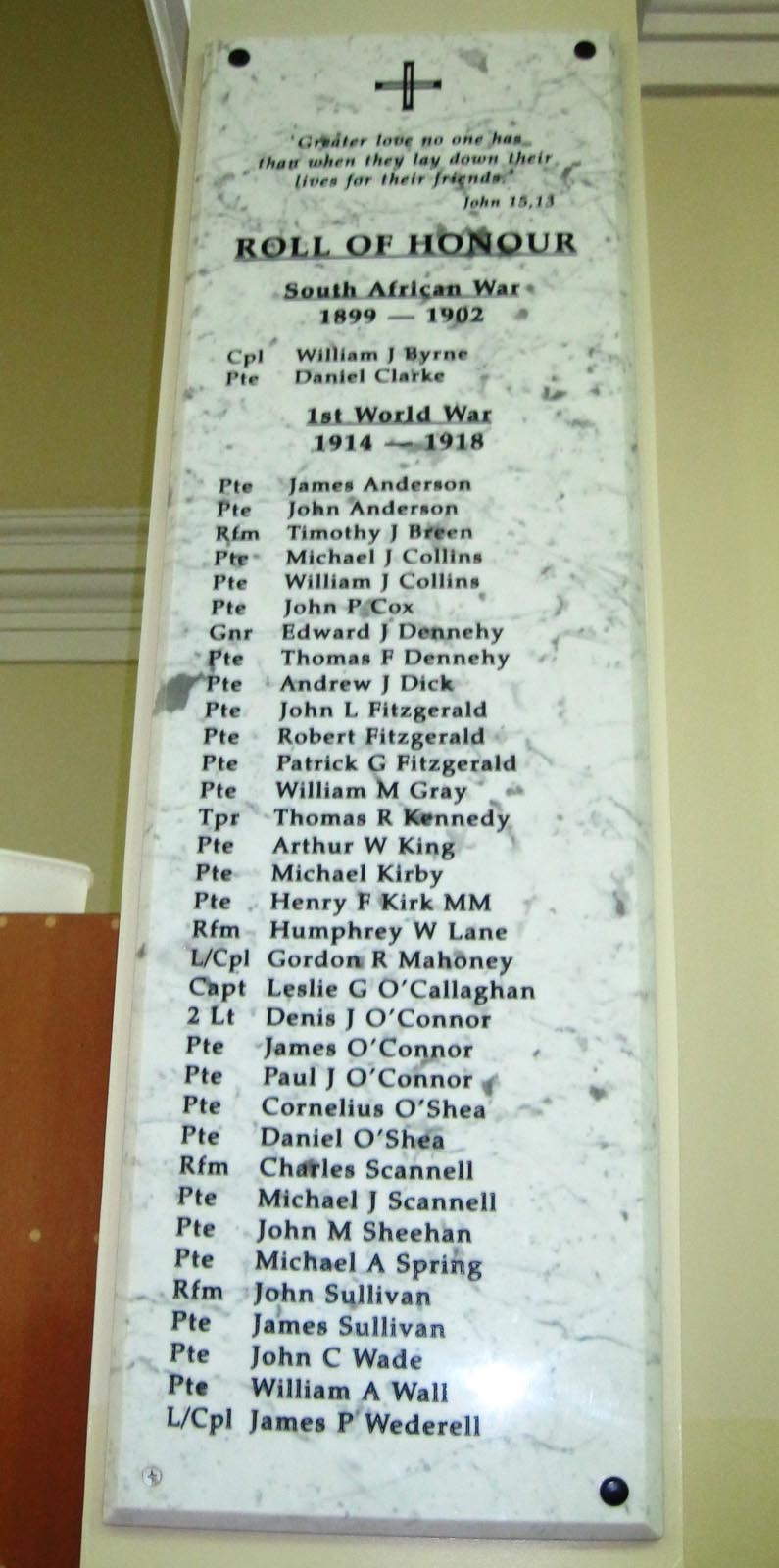
| New Zealand Memorials | Timaru Memorial Wall; Basilica of the Sacred Heart, Timaru; Timaru South School WW1 Memorial plaque; St Mary's Anglican Church, Timaru; Timaru South African War Memorial; Albury Football Club Roll of Honour; Albury War Memorial (as W. WALLS); Fairlie War Memorial (as W. WALLS) | ||
Biographical Notes
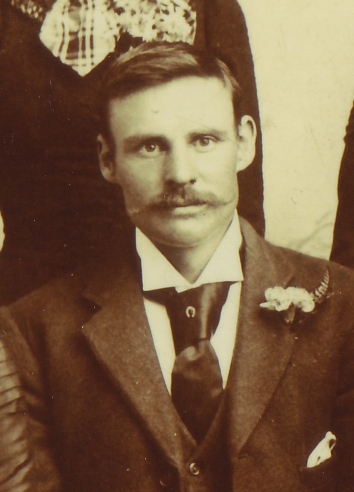
William Arthur Wall, known as Bill, was the eldest son of William Henry and Rebecca Harriett Eliza Nosworthy (née Guscott) Wall, of Timaru. William Henry and Rebecca who married in Devon, England in 1873, emigrated in November 1874 with their first-born, Elizabeth Constance Wall. William Arthur was born on 12 November 1875 at Timaru and baptised on 5 March 1876 at St Mary’s Anglican Church, the family then living at Peeress Town. Four more sons and four more daughters followed, all born at Timaru. Along with all his siblings, Bill was educated at Timaru South School (then also known as the Side School) and Timaru Main School. After starting at Timaru South in February 1881, he transferred to Timaru Main in January 1885, then left for work on turning fourteen. Private Wall finished first when the Timaru Rifles fired for Lieutenant Foden’s prize on 1 February 1894. Then he won Mr J. Hole’s trophy in January 1895. William worked as a blacksmith, at Geraldine in 1897. He was at home at Kensington, Timaru when he attested for service in the South African War on 20 March 1901. He had served as Acting Corporal with the Timaru Rifles for three years. He stood at 5 feet 9 inches, weighed 12 stone one pound and had a chest measurement of 38 inches. 24 years 3 months old, of Church of England affiliation, he named his father as next-of-kin – Mr William Henry Wall, Kensington, Timaru, South Canterbury. The South Canterbury portion of the Seventh Contingent, which included Williaam Wall (farrier), paraded at the Drill-shed on 19 March 1901 and were marched to the station to entrain for Christchurch. 4462 Private W. A. Wall embarked per the “Gulf of Taranto” on 6 April 1901. He served as Farrier Sergeant with the Seventh Contingent in the South African Campaign, receiving the New Zealand Defence Force clasps for South Africa 1901 and South Africa 1902. On discharge on 15 September 1902, he was described as of very good character. Private Wall was back firing with the Timaru Rifles in December 1905. He continued to do so for some years, competing for cups and medals, and providing valuable assistance. W. Wall was one who contributed songs when the Ex-Contingenters’ Association held their first annual reunion and smoke concert in April 1907. He gave songs again at the Timaru Rifles 1908 annual distribution of prizes. W. Wall was elected a vice-president at the annual meeting of the Pirates Football Club in March 1910.
Bill continued to work as a blacksmith for many years in Timaru, until . . . . .
He enlisted at Timaru on 17 August 1914, having been medically examined that day. Standing at 5 feet 8 inches and weighing 160 pounds, he had a chest measurement of 36-39½ inches, a fair complexion, grey eyes and dark brown hair. His sight, hearing and colour vision were all good, his limbs and chest well formed, his heart and lungs normal, his teeth only fair. He was free from diseases, vaccinated, and in good bodily and mental health. He gave his year of birth as 1879 – intentional or not? A blacksmith residing at home, single and of Church of England affiliation, he again named his father as next-of-kin – William Henry Wall, Eward Street, Timaru. He had served with the Timaru Rifle Volunteers for 12 years and with the 7th Contingent, New Zealand Mounted Rifles.
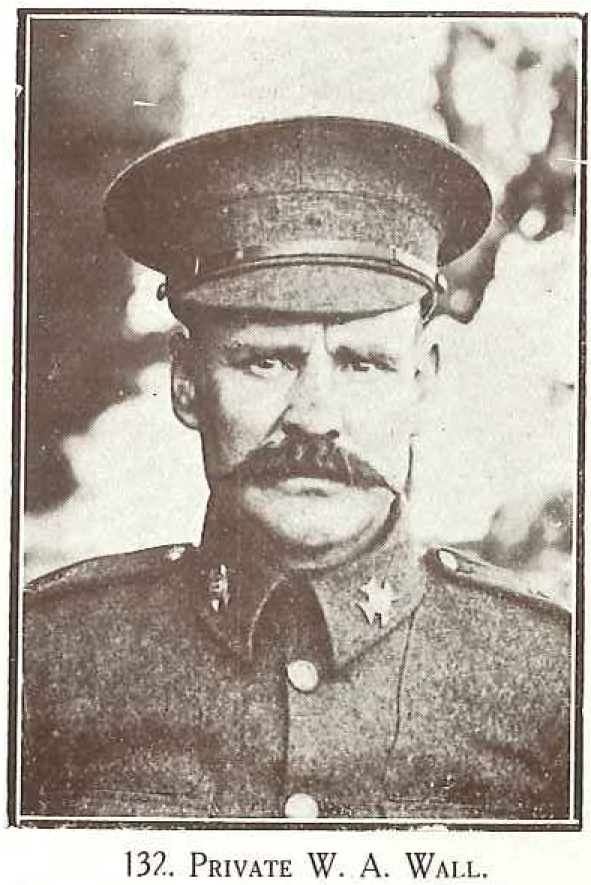
The seventh draft of volunteers from South Canterbury left by the first express for Christchurch on 18 August 1914 to join the concentration camp. The men assembled at the Drill Shed then marched to the station, being cheered at various points en route. At the station they were addressed by the Mayor and the Ven. Archdeacon Jacob, who wished them God Speed and a safe return. They were also congratulated on their loyalty in offering their services for King and country. The Ven. Archdeacon asked God’s blessing on the men and concluded with a short prayer for their safety. The men were loudly cheered as the train drew away from the station, and were in charge of Private Wall, an ex-Contingenter. And, of course, Private W. A. Wall was one of the departing volunteers. Private W. A. Wall was appointed to No. 5 Platoon, B Company (Second South Canterbury Regiment), under Captain D. Grant, at the central camp at Christchurch. Embarking with the Canterbury Infantry Battalion of the Main Body, Private W. A. Wall departed from Lyttelton for Suez, Egypt on 16 October 1914 and disembarked at Alexandria on 3 December.
The lengthy newspaper lists received in June 1915 reported very heavy losses. “Greater love hath no man than to lay down his life for his country.” [Timaru Herald, 18 June 1915.] William Arthur Wall – son of Mr W. H. Wall, a retired railway servant - had been killed in action at the Dardanelles on 8 May 1915, aged 39 years. He is commemorated on the Twelve Tree Copse (New Zealand) Memorial. As William died intestate, the Public Trustee administered the estate of William Arthur Wall, late of Timaru, shoeing smith but lately a member of His Majesty’s New Zealand Expeditionary Forces at the Dardanelles. His property amounted to £31.3s. in accrued pay. William’s medals (1914-1915 Star, British War Medal and Victory Medal), plaque and scroll were all sent to his mother, Mrs Rebecca Wall, 18 Edward Street, Timaru, as his father had died in 1919.
The South Canterbury Ex-Contingenters’ Association held their second annual meeting on 20 May 1915. Bill Wall was named in the annual report as one of the eleven members who had joined the Expeditionary Force. Their comrades wished them luck and looked forward to their safe return. Then at a general meeting at the beginning of November 1915 and again at the third annual meeting in May 1916. it was recorded that he and two other members had been killed in action. Bill was remembered at the 5 July 1915 meeting of the Timaru South School Committee. Pte B. S. Graham, [Percy John] in a letter to his brother of York Street, noted that he was with Charlie Stevenson and Bill Wall when they were hit – “I can tell you that you have no idea what it is like here.” Of twelve in that party, four were killed (Oral Davey, Stevenson and Wall), and four wounded. The other four were the writer, Tom Smallridge, and two Temuka men. (Percy John Graham died of wounds on 6 December 1917 in Belgium.) The Ex-Contingenters’ Association requested the Timaru Borough Council to renovate the inscriptions on the Troopers’ Memorial. When this was done in 1919, additional names were added with this inscription – “This tablet bears the names of the men who served in South Africa and fell in the Great War, 1914-1918.” Ten names were added, including that of Sergeant W. A. Wall. The annual meeting of the Ex-Contingenters’ Association was held in October 1919, when regret was expressed that so many of their members had “gone West”. Their efforts in compiling a Roll of Honour and in getting the Council to renovate and update the Troopers’ Memorial were also noted. Thanks were extended to the Council. And the members who had made the supreme sacrifice and those who had served were honoured.
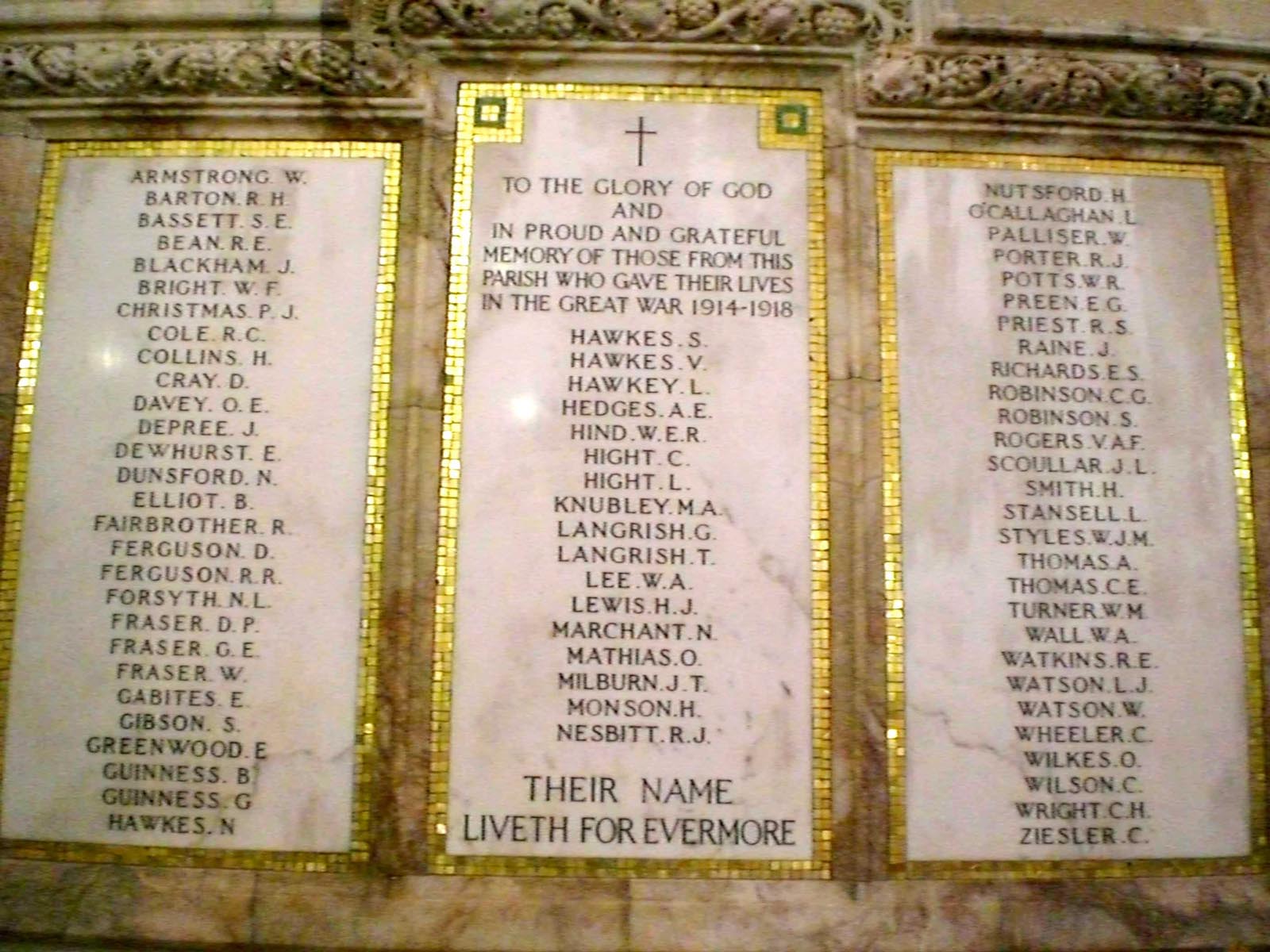
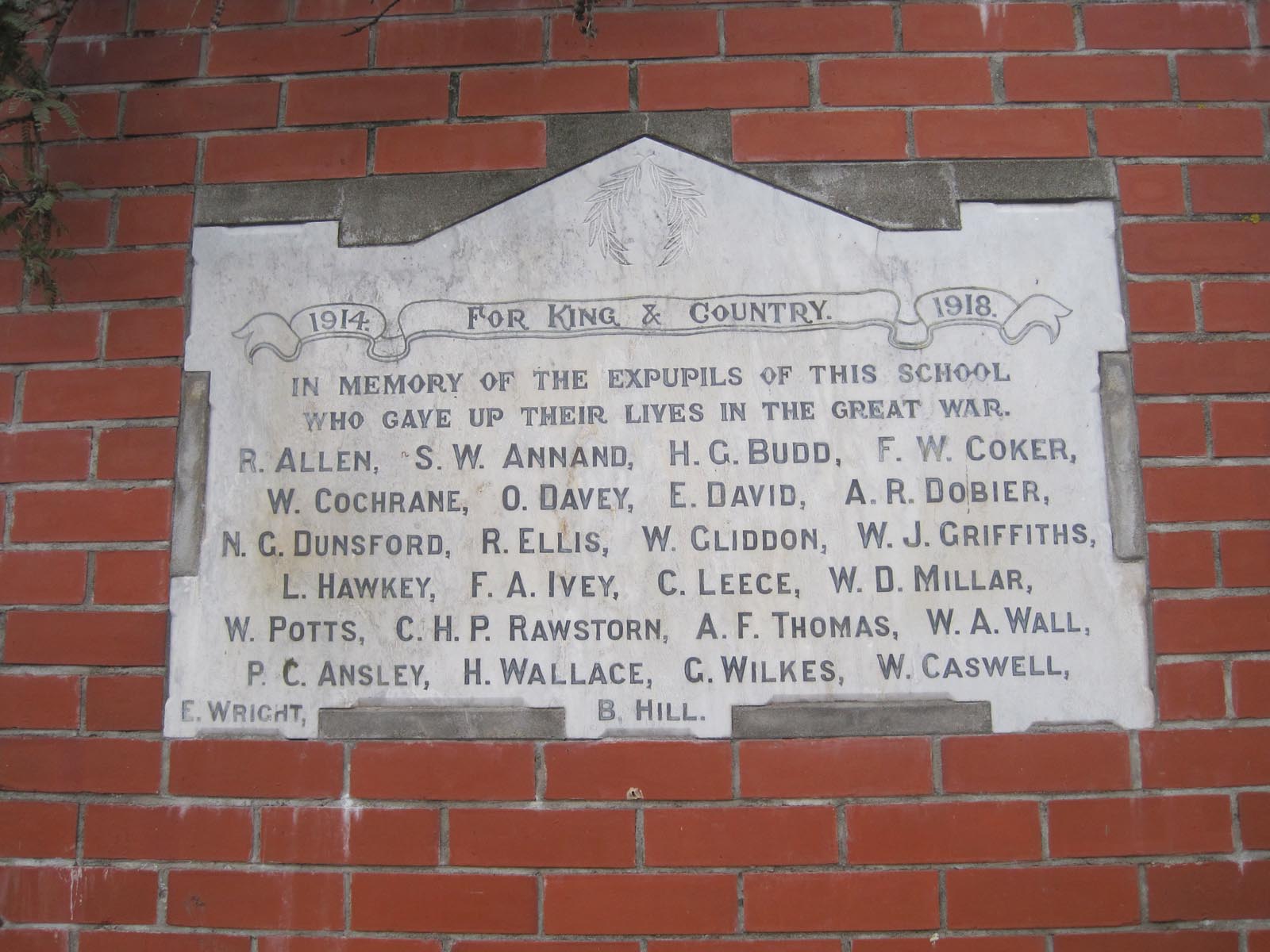
William Arthur Wall is remembered locally on the Timaru Memorial Wall, Timaru South School WW1 Memorial plaque, St Mary's Anglican Church, Timaru, Timaru South African War Memorial, Albury Football Club Roll of Honour, Albury War Memorial and Fairlie War Memorial.
The Timaru South School tablet in memory of ex-pupils who fell in the Great War was unveiled at Timaru South School on 18 September 1919 in a memorable and unique ceremony. “The names of those on the tablet belonged to boys who, only a few years ago, had sat in the same class rooms, under the same teachers and had played on the same playground as the children there that day,” noted the committee chairman. “No nobler boys had left the shores of New Zealand than ex-pupils of the Timaru South School,” said one long-term committee member. Standard VI pupils sang Kipling's “Recessional”, and Standard V pupils recited “Anzac Men,” a stirring poem written by the headmaster. Following the unveiling, an ex-pupil played “The Last Post” and all those assembled sang the National Anthem.
At the Timaru Main School, on Saturday, June 25, 1921, an important ceremony took place, when a very fine monument, standing in the school grounds at the corner of Arthur and Grey streets, was unveiled. The memorial is “a testimony to duty faithfully done, even unto death.” Nine days earlier the foundation stone for this memorial to the ex-pupils of the school who had lost their lives in the Great War, was laid. Scrolls bearing the names of the fallen ex-pupils (70) and of others who had served in the war (361) were inserted in the cavity of the stone.
The St Mary’s Church memorial to the fallen was dedicated by the Bishop of Christchurch on 1 December 1921. The service was conducted by the Bishop, the Archdeacon who had himself served, and the Vicar, and included in the large congregation were the Mayor and Councillors and numerous men who had served in the late war, as well as in the South African war. Following the hymn “God of Our Fathers”, prayer and a scripture reading, the memorial was solemnly unveiled. The hymn “O Valiant Hearts” was then sung, the Bishop spoke briefly, and the service closed with the singing of the National Anthem. Bishop Julius noted that, after the long years of anxiety, fear, hope, sorrow, and loss, and now that peace had been declared, they had assembled to unveil a memorial to those from the parish of St. Mary’s who had given their all—their lives. The memorial, his Lordship said, was a most worthy one in its simplicity, artistic beauty, and character, adding that the names it bore were the names of men who had given their all. The inscription reads: “To the glory of God, and in proud and grateful memory of those from this parish who gave their lives in the Great War, 1914-1918.” Then follow the names (73 in number) of those who made the great sacrifice, and the inscription at the bottom of the tablet: ‘‘Their name liveth for evermore.”
There was a large gathering at Albury on 9 January 1922 to take part in the unveiling of a beautiful ornament erected in the centre of the township to the memory of the brave men — twenty in number — from the Albury district who laid down their lives in the Great War. On the front face of the monument is inscribed: “In honoured memory of the men of Albury district who gave their lives in the Great War 1914 1918. For King and Country.” The names on the monument include W. Walls [sic]. The unveiling ceremony was performed by Mr T. D. Burnett, M.P., and several addresses were given. The proceedings commenced and concluded with the National Anthem. The name W. A. Wall is inscribed on the Albury Football Club’s Roll of Honour for the Great War 1914-1919 in the column headed Killed In Action. At least 69 members of the Albury football Club served in the war, 17 being killed in action.
W. Wall (W. Walls) is honoured on the Mackenzie District War Memorial at Fairlie. The original Mackenzie County War Memorial was unveiled on 16 December 1929. It has since been rebuilt. The parade, including the Timaru Municipal Band, 49 Returned Soldiers, the Executive Committee of the War Memorial, the Mackenzie Pipe Band, and School children from Mackenzie County Schools, formed up at the Post Office and marched to the site of the memorial. After the singing of the National Anthem, and a verse of the Canadian Anthem, the Chairman addressed the gathering, expressing gratification at the fact that at long last they were met to unveil and dedicate the memorial to the soldiers from the Mackenzie County who fell in the Great War. The design was unique in South Canterbury. It was not a cenotaph, or solely a monument of those buried elsewhere. It expressed more than that. It was a catafalque, a cairn upon which symbolically the remains of the Unknown Warrior were elevated and were contained in the representation of a casket at the top of the structure. The base was composed of glacial boulders, and the shaft of limestone blocks. The whole erection was therefore constructed of indigenous stone. Thus, symbolically the Warrior rested on his native soil. The wreath above the tablet, composed of laurel leaves carved in stone symbolised victory. The tablet on which the names were inscribed is of marble. In a lengthy address, Father Barra, who had himself served as a chaplain, outlined clearly the campaigns throughout which New Zealanders had served, fought and died. They had “stood up in their splendid manhood, enthusiastically responding from the first to the call of their country.” He paid sensitive and abundant tribute to all involved in any role in the conflicts. An avenue of oak trees commemorating Fairlie’s fallen soldiers, lines its main street.
William A. Wall, the beloved son of William and Rebecca who was killed in action on Gallipoli for King and Country, is remembered on his parents’ headstone in the Timaru Cemetery. William Henry Wall died in June 1919. Since his arrival in New Zealand, he had been with the railway service. When the Benvenue and City of Perth were wrecked in 'the Timaru roadstead in May 1882, Mr Wall was a member of one of the boat crews which put out to the rescue, and his name is inscribed on the monument erected in Sophia Street to commemorate the heroism of the rescuers. A Roll of Honour notice in 1916 read “He gave his life for others.” And again in 1917. An In Memoriam notice in 1918 read “He gave his life for the Empire.” In 1919, William’s loving parents inserted a Roll of Honour notice – “He died for others.” Mrs Rebecca Wall inserted In Memoriam (Roll of Honour) notices regularly for many years - 1920 “He gave his life for others”, 1921 “Deeply regretted”, 1922, 1923, 1924 “late Farrier-Sergeant, 7th South African Contingent, killed at Gallipoli, May 8th, 1915”, 1926 “Greater love hath no man than this”, 1927, 1928, 1929, 1930, 1931 “In loving memory” - in the newspaper in memory of her eldest son. Mrs Rebecca Wall who died at Timaru in June 1932 was remembered for her hospitality. She was survived by five daughters and four sons, only William Arthur having predeceased her. Bill’s youngest brother, George Alfred Wall, who had married in 1916 was called up in 1917. Frederick Thomas Wall was listed on the Reserve Rolls, married with two children; Albert Edward Wall was also listed, married with one child. Three nephews are known to have served in World War One – William Albert (Wall) Spavin, John Guscott Mathews, Clarence Albert Booth.
Sources
Auckland War Memorial Museum Cenotaph Database [21 July 2013]; NZ Defence Force Personnel Records (Archives NZ Ref. AABK 18805 W5515 0005780) [July 2013]; CWGC [16 August 2013]; Timaru Cemetery headstone image (Timaru District Council) [12 September 2013]; NZ BDM Indexes (Department of internal Affairs); Timaru Herald, 6 February 1894, 19 January 1895, 20 March 1901, 18 December 1905, 5 April 1907, 16 April 1908, 2 March 1910, 19 August 1914, 19 May 1915, 14 June 1915 [x 3], 3 November 1915, 8 & 27 May 1916, 8 May 1917, 8 May 1918, 8 May 1919, 4 June 1919, 12 July 1919, 19 September 1919, 27 October 1919, 8 May 1920, 16 September 1920, 9 May 1921, 17 & 27 June 1921, 2 December 1921, 8 May 1922, 8 May 1923, 8 May 1924, 8 May 1925, 8 May 1926, 7 May 1927, 2 March 1928, 8 May 1928, 8 May 1929, 16 December 1929, 8 May 1930, 8 May 1931, 18 & 21 June 1932, Press, 21 & 28 August 1914, Evening Post, 14 June 1915, Press, 14 June 1915, 17 August 1915, Evening Star, 15 June 1915, Otago Daily Times, 17 June 1915, Otago Witness, 23 June 1915, Temuka Leader, 5 June 1919, 12 January 1922 (Papers Past) [14 September 2013, 19 November 2013; 16 March 2014; 11 May 2014; 31 August 2014; 30 May 2015; 21 June 2015; 21 January 2017; 07 & 15 February 2018; 29 & 30 January 2020; 10 February 2020; 07 April 2020; 08 June 2020; 10 March 2022; 05 May 2022; 02 January 2024]; School Admission records (South Canterbury Branch NZSG); Timaru Herald, 7 May 1927, 8 May 1930 (Timaru District Library) [11 May 2014; 22 January 2017]; Probate record (Archives NZ/FamilySearch) [10 May 2015]; St Mary’s Timaru Baptism records (South Canterbury Branch NZSG) [30 September 2021]; NZ Electoral Rolls (ancestry.com.au) [2013; 01/01/2026]; Photo of William Arthur Wall on family tree – copied courtesy of F. Spavin [September 2013]
External Links
Related Documents
Researched and Written by
Teresa Scott, SC Genealogy Society
Currently Assigned to
TS
 Licensed under a Creative Commons Attribution-NonCommercial 4.0 International License unless otherwise stated.
Tell us more
Do you have information that could be added to this story? Or related images that you are happy to share? Submit them here!