Birch Hill Station, Rangiora, Canterbury, New Zealand
Occupation
Teamster
Previous Military Experience
Marital Status
Single
Next of Kin
Mrs George Tait (mother), Peel Forest, South Canterbury, New Zealand
Religion
Presbyterian
Medical Information
5 foot 10 inches tall, weight 168 pounds (76kgs), chest 33-37 inches, fair complexion, blue eyes, brown hair, good teeth
Military Service
Served with
NZ Armed Forces
Served in
Army
Military District
Embarkation Information
Body on Embarkation
14th Reinforcements
Unit, Squadron, or Ship
Canterbury Infantry Battalion, C Company
Date
26 June 1916
Transport
HMNZT57 Tahiti
Embarked From
Wellington, New Zealand
Destination
Devonport, England
Other Units Served With
Last Unit Served With
2 Battalion Canterbury Infantry Regiment
Military Awards
Campaigns
Western European
Service Medals
British War Medal, Victory Medal
Military Awards
Award Circumstances and Date
No information
Prisoner of War Information
Date of Capture
Where Captured and by Whom
Actions Prior to Capture
PoW Serial Number
PoW Camps
Days Interned
Liberation Date
Discharge
Date
Reason
Hospitals, Wounds, Diseases and Illnesses
17-27 May 1917 - admitted to 3 NZ Field Ambulance - bronchitis.
8-23 July 1917 - admitted to 1 NZ Field Ambulance - transferred to 9 Australian Field Ambulance - myalgia.
10 Aug 1917 - admitted to 3 NZ Field Ambulance - pleurisy; transferred to 2 Australian Casualty Clearing Station (CCS); 11 August, transferred to 3 Australian General Hospital, Abbeville. Died 15 Sep 1917
Post-war Occupations
Death
Date
15 September 1917
Age
34
Place of Death
3 Australian Generasl Hospital, Abbeville
Cause
Died of disease - Pleurisy with effusion
Notices
Memorial or Cemetery
Abbeville Communal Cemetery Extension, Somme, France
Memorial Reference
III. C. 10.
New Zealand Memorials
On Memorial wall, Timaru; Geraldine War Memorial; Peel Forest War Memorial, Birch Hill Station War Memorial
Biographical Notes
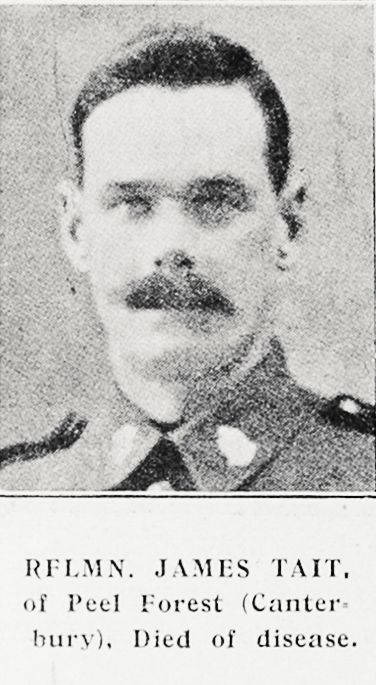
James was born at Ashburton on 7 May 1883. His father George, born at Forfar, Aberdeenshire, Scotland in 1840, had arrived in New Zealand about 1866, and later died at Timaru on 28 June 1931. George married Ann Comrie in Timaru in 1871 and the couple went on to have nine children, James being the seventh child. Later Ann unfortunately died at Peel Forest on 21 September 1917, only 6 days after her son James. Both parents are buried in the Timaru Cemetery. The family lived in the Pleasant Point and Seadown area where George carried out his business of Blacksmith, before later moving to Peel Forest. James registered for military service and was medically boarded at the Kaiapoi Defence Office in October 1915, but was not enlisted until 7 March 1916. At this time he was employed as a teamster by E.B. Milhan of Birch Hill Station, Rangiora. He nominated his mother Ann of Peel Forest as his next of kin and was described on his enlistment papers as being single, aged 33 years, Presbyterian, 5 foot 10 inches in height, weighing 168 pounds (76kgs), chest measuring 33–37 inches, having a fair complexion, blue eyes, brown hair and good teeth. Private Tait entered camp at Trentham on 9 March 1916 and began five weeks of basic drill and weapon training, before moving to Featherston Camp to complete more advanced infantry training. On 26 June at Wellington, he boarded HMNZT57 “Tahiti” as part of the 14th Reinforcements Canterbury Infantry Battalion, C Company, sailing in convoy with HMNZT56 “Maunganui”. With 2,122 other troops he arriving at Devonport, England, on 22 August 1916. Immediately on arrival he was posted to Sling Camp for further training with the Canterbury Company before leaving for France on 19 September, where he entered the NZ Depot at Etaples. On 3 October he joined the 2nd Battalion Canterbury Infantry Battalion in the field. On 6 October James and the 2nd Battalion left Fricourt, and after a long and trying march reached their billets at Bailleul (Somme). Here they spent 4 days reorganising and training before marching to Pont Remy and entraining for Bailleul (Flanders) and on to the Hazebrouck road. From here they NZ Division was ordered to relieve the 5th Australian Division which was holding the Sailly Sector. The sector was a very quiet one. After the first tour of eleven days in the line, the battalion settled down to regular reliefs of eight days in the line and eight days in billets in the Rue des Fiefs, a road running south-east from the village of Sailly. Reinforcements arrived steadily, and both the battalions rapidly came up to strength. The remainder of the year was fairly quiet and they spent the winter on the River Lys, near Armentieres. Early in 1917 they moved into the Messines area. The first weeks of May saw 300 men of the 2nd Battalion engaged on light railway construction with a Canadian Light Railway Company while the rest were employed on work in the forward areas. On 17 May 1917, James was sent sick to hospital and admitted to No3 NZ Field Ambulance in the field with bronchitis, before returning to his unit on May 27. On the night of June 6/7 the 2nd Battalion moved out to its assembly trenches in preparation for the Battle of Messines. Zero hour for the attack was 3.10am on June 7 and by 4.58am they had captured all their objectives and on June 8, were relieved by the 1st Wellington Battalion, then went into Battle Reserve trenches. On this day the regiment suffered a severe loss through the death of the Rev. Father J. J. McMenamin, who was killed while burying the dead. He had been with the 2nd Battalion since it was formed, and was loved and respected by every officer and other rank who had known him. On 30 June the Division was relieved in the line by the 4th Australian Division. On 8 July James was again admitted sick with myalgia to the No1 NZ Field Ambulance and readmitted to the 9th Australian Field Ambulance the same day before re-joining his unit on 23 July. While he was away the 2nd Battalion had left Neuf Berquin and had returned to its old quarters at Romarin, from where it supplied working-parties to the front line. After the capture of La Basse Ville, it carried up the wire and standards required by the Pioneer Battalion for the work of wiring in front of the new positions. On the night of August 5/6, the battalion relieved the 2nd Otago Battalion in the outpost line at La Basse Ville and to the left of that village, having the 1st Canterbury Battalion on its immediate right. On 10 August Private Tait was again sick, being admitted to No3 NZ Field Ambulance with pleurisy and from there was transferred to No2 Australian Casualty Clearance Station. From here he was sent to No3 Australian General Hospital at Abbeville the next day, and on 13 August was reported as dangerously ill. A week later he was transferred from the dangerously ill to the seriously ill list. Finally, on 15 September 1917, James died of “pleurisy with effusion” and was buried in the Abbeville Communal Cemetery Extension, Somme, France. After the war his father George of Peel Forest, Geraldine, was sent his war medals consisting of the British War Medal and Victory Medal, plus a scroll and plaque. James name is commemorated on the Timaru Memorial Wall, Geraldine War Memorial, Peel Forest War Memorial and Birch Hill Station War Memorial. Two brothers of James also served during the First World War: 29315 Bombardier Joseph Tait as a Farrier with the NZ Field Artillery in the UK; and 47373 Private Henry Tait as an infantry man in France with the Canterbury Infantry Regiment, where he received gunshot wounds to the chest. Both survived to return home.
Sources
New Zealand ANZACs in the Great War 1914-1918 (University of New South Wales) at https://nzef.adfa.edu.au/showPerson?pid=249481; "The Call for men. Yesterday's recruiting" in the Star 5 November 1915, "Roll of Honour" in the Timaru Herald 21 September 1917, and "Roll of honour" in the Ashburton Guardian 22 September 1917, all courtesy of Papers Past at https://paperspast.natlib.govt.nz/; New Zealand War Graves Project at https://www.nzwargraves.org.nz/cemeteries/abbeville-communal-cemetery-extension
 Licensed under a Creative Commons Attribution-NonCommercial 4.0 International License unless otherwise stated.