DICK, Andrew Joseph
(Service number 6/809)
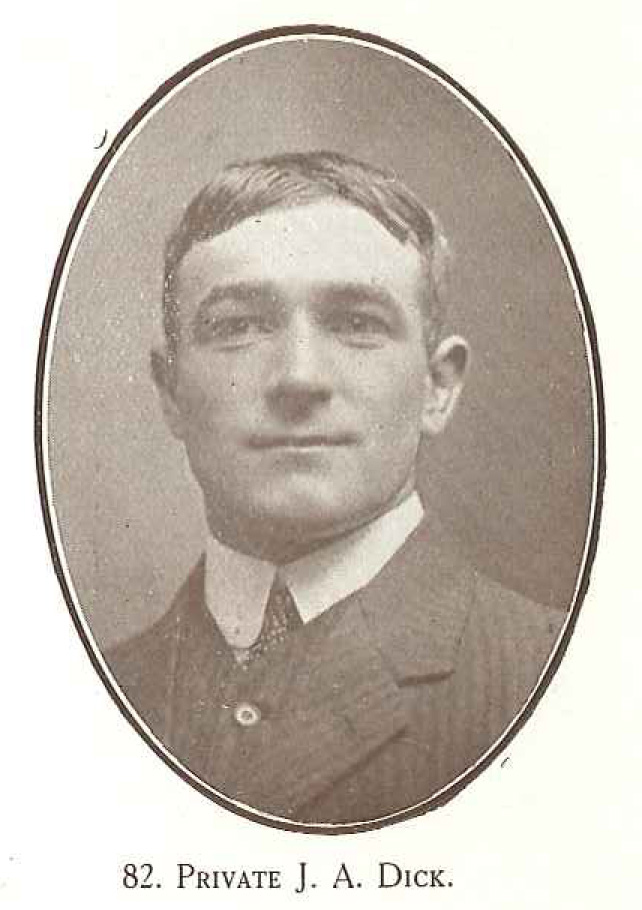
| First Rank | Private | Last Rank | Private |
|---|
Birth
| Date | 08/12/1883 | Place of Birth | Timaru |
|---|
Enlistment Information
| Date | 18 August 1914 | Age | 31 years |
|---|---|---|---|
| Address at Enlistment | Queen Street, Timaru | ||
| Occupation | Slaughterman | ||
| Previous Military Experience | |||
| Marital Status | Single | ||
| Next of Kin | Mrs M. DICK, 1 Queen Street, Timaru | ||
Military Service
| Served with | NZ Armed Forces | Served in | Army |
|---|
Embarkation Information
| Body on Embarkation | Main Body | ||
|---|---|---|---|
| Unit, Squadron, or Ship | Canterbury Infantry Battalion | ||
| Date | 16 October 1914 | ||
| Transport | Tahiti or Athenic | ||
| Embarked From | Lyttelton, Canterbury | Destination | Suez, Egypt |
| Other Units Served With | |||
|---|---|---|---|
| Last Unit Served With | Canterbury Infantry Regiment | ||
Military Awards
| Campaigns | Egyptian; Balkans (Gallipoli); Western European | ||
|---|---|---|---|
| Service Medals | 1914-15 Star; British War Medal; Victory Medal | ||
Award Circumstances and Date
No information
Prisoner of War Information
| Date of Capture | |
|---|---|
| Where Captured and by Whom | |
| Actions Prior to Capture | |
| PoW Serial Number | |
| PoW Camps | |
| Days Interned | |
| Liberation Date |
Death
| Date | 17 December 1917 | Age | 34 yrs |
|---|---|---|---|
| Place of Death | No. 2 Casualty Clearing Station, Belgium, France | ||
| Cause | Died of wounds received in action | ||
| Memorial or Cemetery | Lijssenthoek Military Cemetery, Poperinge, West-Vlaanderen, Belgium | ||
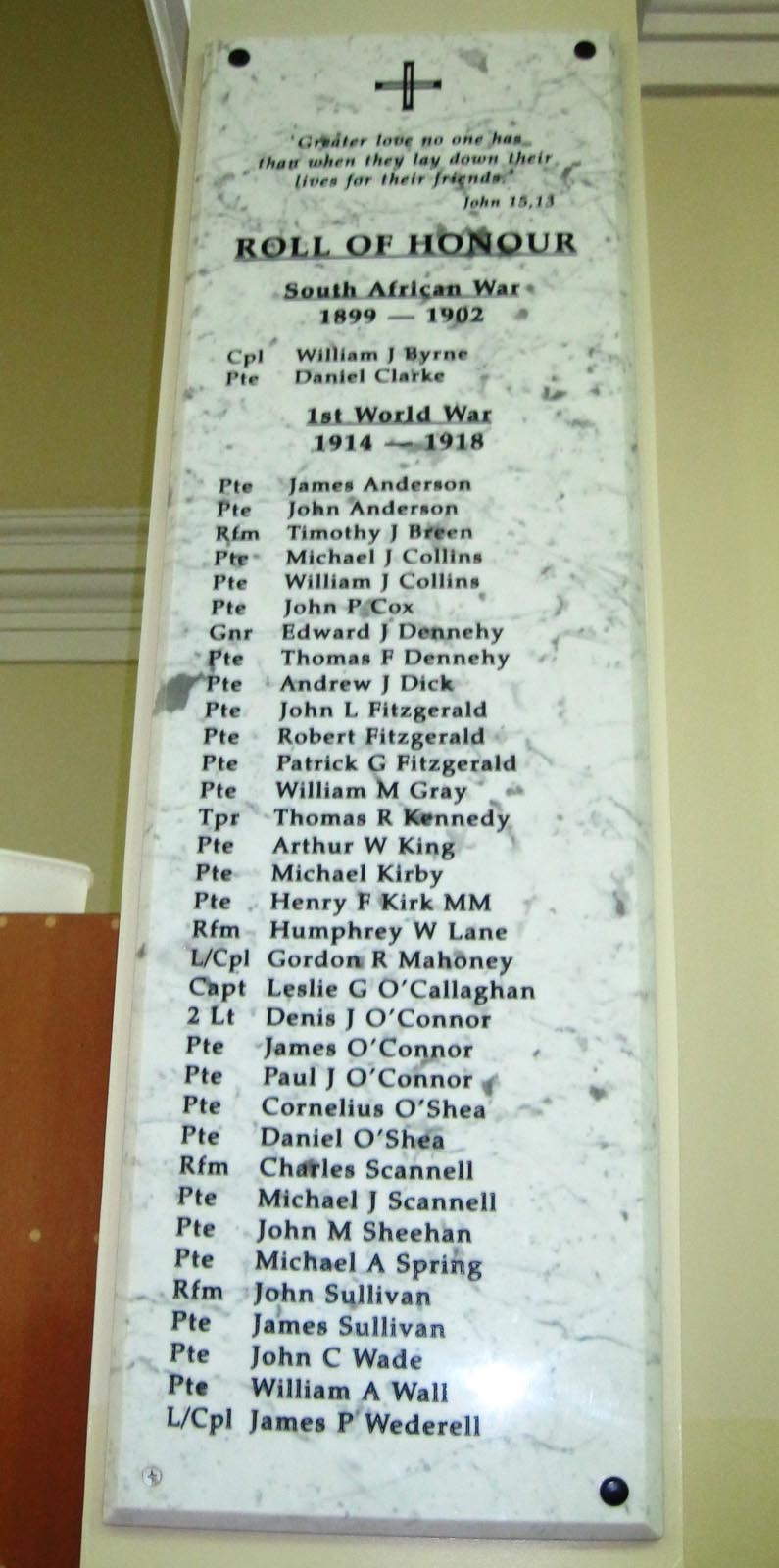
| New Zealand Memorials | Timaru Memorial Wall (J. A. DICK); Basilica of the Sacred Heart (Dick Andrew J.) | ||
Biographical Notes
Andrew Joseph Dick, born on 8 December 1883 at Timaru, was the second son of John Reid Dick, a wharf labourer, and Catherine (Kate) née Gallon, of Timaru. He was baptised soon after, on 25 December 1883, in the Roman Catholic Parish of Timaru. His mother died in April 1887 when Joseph was just three years old, and not long after the death of his youngest brother Robert. The following year his father married Mary O’Donnell, who became the mother he knew and was named as his next-of-kin. Joseph’s half-brother Francis died in 1898 at the age of nine. He was known as Joseph or Joe, enlisting and dying as Joseph Andrew Dick. As early as December 1906 he demonstrated a generosity of spirit, his subscription of 5 shillings to the Home Rule Fund being acknowledged.
Having enlisted on 18 August 1914, at the outbreak of war, he was a Private in the Second South Canterbury Company under commanding officer Captain D. Grant. Joe was a 31 year old slaughter man for the Christchurch Meat Company at Pukeuri, only 5 feet 5⅜ in height, with a small distinctive scar on his neck, single and Roman Catholic. He was one of several infantry men who left Timaru in mid August 1914 for the central camp at Christchurch. Joseph embarked with the First Reinforcements of the Main Body on 16 October 1914, destined for Egypt. After participating in the landing at Gallipoli, 6/809 Private J. A. Dick, of Timaru and attached to the Canterbury Infantry Battalion, was wounded on 5 May 1915 at the Dardanelles, and subsequently admitted to the Southern General Hospital at Birmingham, England. Joe wrote to his sister from Gibraltar on 5 May – “All of us who were not seriously wounded are going to England. I was shot close to the left eye, but it is not a serious wound. I was wonderfully lucky to have escaped death as I did, hundreds of times.” He also said that Major Grant, of Timaru, had been shot in the daytime and had died of his wounds.
Joseph Andrew Dick was one of a number of wounded men in Birmingham Hospital who were visited by the High Commissioner on 17 May 1915. The High Commissioner cabled the Prime minister - “I paid a visit to Birmingham Hospital yesterday and saw a number of wounded men belonging to the Expeditionary Force, and was present when others arrived. All were in good heart, cheerful and anxious to return to active service. Some hope to be soon convalescent.” The bandaged men in war-torn uniforms who arrived on the day presented a “pathetic sight”. As the ambulances drove up the people of Birmingham cheered. Many flowers were sent to the hospital, and some of the soldiers lying on stretchers had flowers in their hats. A number who had been severely wounded had been greatly improved by the voyage and were out of danger. A week later it was reported that Joe was progressing favourably. He was, however still in the hospital in late June but reported as “slight”.
Private Joseph Andrew Dick recovered and on 23 July left London by Government Transport to rejoin the force at the Front. He returned to the Dardanelles on 10 August, only to be admitted to the Hospital Ship a few weeks later, suffering from dysentery, and then to hospital at Alexandria, with fever. On 5 November 1915 he was again wounded. He was discharged, convalescent, from Alexandria and, it appears, returned to Gallipoli. He was there for the evacuation of the Peninsula, when over four nights from 15 December 1915 the troops were shipped out, the withdrawal from the front-line trenches taking place on 19 December.
Some time before Christmas 1915 the railway men of South Canterbury forwarded about 50 tins of Christmas gifts, of about £30 in value, to the South Canterbury soldiers at the Front. The secretary of the fund received numerous acknowledgements of the gifts from men in Egypt, all full of praise and appreciation of the kindness of the senders. The gifts were all packed in tin holders, especially made out of petrol and motor spirit tins, and the boys stated that the tins were exceedingly useful for the purpose of cooking, etc. Among the Timaru men who received gifts was Joe Dick, of the Second (South Canterbury) Regiment. Mr J. H. Whyte received a letter dated 20 October 1916 from his son Robert, in a “dug-out in France”, in which Private Robert Whyte says that he was again with his old Company, and it was “quite homely in a way to be with many of the Timaru boys. . . . . Joe Dick, . . . and lots of others that I know are here with us.” He continues “We are all well and in the best of spirits, . . . . Most of the boys are looking well though some of them have had a long and rough time.”
It was early April 1916 when Joseph left Port Said for France. For two months in 1917 he was attached to the Divisional Signalling Company. On 22 August 1917 Private J. A. Dick was admitted to Walton-on-Thames Hospital, having been wounded with shrapnel in the left leg. Before long the reports were that 34-year old Joseph had been wounded in action and admitted to the Field Ambulance on 15 December. He had died of his wounds on 17 December 1917 at the No. 2 Casualty Clearing Station in Belgium, one of ten men who died of wounds recorded in Casualty List No. 752. He suffered extensive wounds - to his left knee, right leg, left buttock and shoulder. He was buried in the Lijssenthoek Military Cemetery, Poperinge, West-Vlaanderen, Belgium.
His brother, James Alfred Dick, had gone to the front in early 1916 and was serving when Joseph died. A half-brother, Hugh Aloysius Hilary Dick (known as Hilary), was called up when he turned twenty in 1917. Two sisters – Nellie (Mrs E. Sinclair) and Mary (Mrs G. Sauer), who had both settled in the Feilding district – continued to remember their brother with In Memoriam notices.
Could we, his sisters, have clasped his hand - The brother we loved so well. Or kissed his brow when death was near, And whispered, “My brother, farewell.”
His cousin William Wade who served with the Australian Forces, was killed in action in 1917. And cousins, John James Gallen and William James Gallen, also served in World War I. His medals - 1914-15 Star; British War Medal and Victory Medal – were sent to his father, as were the plaque and scroll in December 1921. Joseph Andrew Dick is commemorated on the Timaru Memorial Wall (as DICK J. A.) and the Basilica of the Sacred Heart Memorial (as DICK Andrew J. Dick)
Sources
Auckland War Memorial Museum Cenotaph Cenotaph Database [21 July 2013]; NZ Defence Force Personnel Records (Archives NZ Ref. AABK 18805 W5537 0033739) [08 August 2013]; CWGC [31 July 2013]; Timaru Herald, 30 March 1887, 23 April 1887, 2 July 1898, 12 December 1906, 21 August 1914, 7, 19 & 27 May 1915, 6 July 1915, 6 May 1916, 19 December 1916, 6 September 1917, 1 January 1918 [x 2], Press, 21 August 1914, 7, 8 & 19 May 1915, Sun, 5 September 1914, 18 August 1915, Waimate Daily Advertiser, 7 May 1915, New Zealand Herald, 19 May 1915, Star, 26 May 1916, Southland Times, 3 July 1915, Feilding Star, 6 August 1915, 2 January 1918, 17 December 1918, 17 December 1919, 17 December 1920, New Zealand Times, 19 August 1915, Evening Post, 11 November 1915, 31 December 1917 (Papers Past) [31 July 2013; 11 December 2013, 18 November 2013; 02 February 2014; 11 & 12 February 2015; 24 April 2015; 8 March 2017, 16 September 2017]; NZ BDM historical records indexes (Department of Internal Affairs) [July 2013]; NZ Electoral Rolls (ancestry.com.au) [2013; 15 September 2017]; Roman Catholic Baptisms Timaru (Christchurch Diocese CD held by South Canterbury Branch NZSG) [12 March 2017]
External Links
Related Documents
Researched and Written by
Teresa Scott, SC branch NZSG
Currently Assigned to
TS
 Licensed under a Creative Commons Attribution-NonCommercial 4.0 International License unless otherwise stated.
Tell us more
Do you have information that could be added to this story? Or related images that you are happy to share? Submit them here!