BROSNAHAN, Timothy Edward
(Service number 43946)
| First Rank | Private | Last Rank | Private |
|---|
Birth
| Date | 8 February 1895 | Place of Birth | Temuka |
|---|
Enlistment Information
| Date | 13 December 1916 | Age | 21 years 10 months |
|---|---|---|---|
| Address at Enlistment | 330 Manchester Street, Christchurch | ||
| Occupation | Carpenter | ||
| Previous Military Experience | |||
| Marital Status | Single | ||
| Next of Kin | T. E. BROSNAHAN (father), 330 Manchester Street, Christchurch | ||
Military Service
| Served with | NZ Armed Forces | Served in | Army |
|---|
Embarkation Information
| Body on Embarkation | New Zealand Expeditionary Force | ||
|---|---|---|---|
| Unit, Squadron, or Ship | 24th Reinforcements, Canterbury Infantry Regiment, C Company | ||
| Date | 26 April 1917 | ||
| Transport | Pakeha | ||
| Embarked From | Wellington | Destination | Plymouth, Devon, England |
| Other Units Served With | |||
|---|---|---|---|
| Last Unit Served With | Canterbury Infantry Regiment | ||
Military Awards
| Campaigns | Western European | ||
|---|---|---|---|
| Service Medals | British War Medal; Victory Medal | ||
Award Circumstances and Date
No information
Prisoner of War Information
| Date of Capture | |
|---|---|
| Where Captured and by Whom | |
| Actions Prior to Capture | |
| PoW Serial Number | |
| PoW Camps | |
| Days Interned | |
| Liberation Date |
Death
| Date | 30 August 1982 | Age | 87 years |
|---|---|---|---|
| Place of Death | Lower Hutt | ||
| Cause | |||
| Memorial or Cemetery | Taita Lawn Cemetery, Lower Hutt | ||
| New Zealand Memorials | |||
Biographical Notes
Timothy Edward Brosnahan, known as Edward or Ted, was born on 8 February 1895 at Temuka, the eldest son of Timothy (or Timothy Edward, Edward being his father’s name; known as Tim) and Catherine (née Lavery) Brosnahan. He was baptised Roman Catholic at Timaru nine days later on 17 February 1895. Timothy, senior, and Catherine who were both New Zealand-born, married in 1894 (the year Tim’s youngest brother William Joseph was born) and had three sons and one daughter, the youngest son Raymond Joseph dying in 1904, aged 5 years. Their first two children (Timothy Edward and Kathleen Margaret) were born at Temuka before the family moved to Christchurch in the early 1900s, Tim taking employment with the railways. While at Temuka, Timothy senior was a prominent cricketer and footballer and well-known as an athlete. Ted was to display the same sporting prowess as his father, playing rugby for Christchurch Marist and Canterbury and cricket for East Christchurch and Canterbury. He represented the South Island in the Inter-Island rugby match in 1919 (an achievement recalled in the Timaru Herald on 31 August 1945). T. E. Brosnahan was the highest scorer with 57 runs when East Christchurch defeated St Albans at cricket in February 1916.
Young Timothy’s (Edward’s) early education was at the Christchurch Marist Brothers’ School where he was placed second for Standard III Aggregate Merit in 1904. He received the prize for first place in Standard IV diligence in 1905. The following year Ed. Brosnahan received two Standards IV and V prizes, for 2nd place for writing and 2nd place for regular attendance. The schools of North Canterbury made their annual excursion to Lancaster Park on 24 November 1906 for the purpose of holding the great athletic carnival that is the chief function of the schools’ athletic year. Boys and girls ran, jumped, skipped and bowled their hoops, or rode their bicycles, and thousands of their fellows lined the fences to cheer their favourites to victory. E. Brosnahan and his uncle W. Brosnahan (Marist Brothers) won the boys’ Siamese Race under 11 years. Tim and Catherine were living in Timaru (Craigie Avenue) for a time in the 1910s, their three surviving children being educated there. They were in fact, in Timaru in 1909, both Ed and his brother Leo performing at the Catholic Boys School entertainment in the Theatre Royal in November 1909. Ed. Brosnahan was one of the peasants in the drama “The Blind Prince”, the peasants being particularly well placed and all acquitting themselves creditably. The following March the Timaru Marist Brothers took their entertainment to Waimate, Ed. Brosnahan brightly playing the part of neighbour Molina. He also sang “The Wearing of the Green”, and he and brother Leo did battle for various countries in the international singing contest. Seating accommodation in Timaru’s Theatre Royal was at a premium on 8 November 1910 when a concert of a highly credited order was given by the Marist boys. A duet by Edward and Leo Brosnahan – “Erin the Tear and the Smile” – was very nicely sung. From 1914, when the family appears to have moved to Christchurch, E. Brosnahan was a regular in the Christchurch East cricket team. The team had a big win against Riccarton in their cricket match in November 1914, Edward retiring on 64 runs and his brother Leo also contributing. Both E. Brosnahan and T. Brosnahan (father and son?) played in December when East Christchurch defeated Linwood. E. Brosnahan was named in the backs for the Marists team which played, and lost, a rugby match on 17 July 1915.
Timothy Edward Brosnahan, apprentice carpenter, 330 Manchester Street, Christchurch, was listed on the 1916 Reserve Rolls. He was called up when his name was drawn in the first ballot on 23 November 1916. Timothy Edward Brosnahan actually enlisted at Temuka (or Christchurch), on 13 December 1916. He had been medically examined at Temuka that day. He stood at 5 feet 3 inches and weighed 8 stone 9 pounds. (119 pounds), with a chest measurement of 32-35 inches. His complexion was fair, his eyes grey and his hair brown. His sight, hearing, colour, heart and lungs were all normal, his limbs and chest well formed. Free from diseases, vaccinated, and in good bodily and mental health, he was passed Class A. He had registered for compulsory military training at Timaru and was now offering for the 24th Reinforcements. Employed as a carpenter in Christchurch, single and Roman Catholic, he named his father as next-of-kin – Mr T. E. Brosnahan, 330 Manchester Street, Christchurch.
There amongst the Christchurch men of the 24th Reinforcements who left for Wellington in the evening of 5 January 1917 was T. E. Brosnahan, for Trentham Cam (Infantry). The parade was called for six o’clock in the King Edward Barracks, and here the men from Group IX (Christchurch) and Group XI (North Canterbury) assembled. There was a fair-sized crowd of members of the public, chiefly friends and relations, who were seeing the men off. Colonel Chaffey, in addressing the men before their departure, hoped that those of the 24th Reinforcements would show their friends that they possessed the same fine spirit as the men who had gone before. “He knew that many of the men who were going now were giving up more from a business point of view than many who had gone previously, and many of them had made great sacrifices. But it should be a pleasure to them to be allowed the privilege of making a sacrifice for the honour of the Empire and the great cause for which they were fighting in the biggest war ever known.” The drafts, headed by the band of the 1st Mounted Regiment (C.Y.C.) then marched down to the station, being followed by a large crowd of people who applauded the men loudly en route, and gave them a rousing cheer as the train moved out of the station.
By 6 January 1917 he was at Trentham where he was inoculated, then at Featherston on 8 January. Having first embarked at Wellington on 14 April 1917, T. E. Brosnahan returned to Wellington on 17 April. Private T. E. Brosnahan then embarked with the Canterbury Infantry Regiment of the 24th Reinforcements, departing from Wellington on 26 April 1917 per the “Pakeha”. Disembarking at Sydney on 2 May, he re-embarked there a week later. He disembarked at Devonport, England on 28 July, marched into Sling and was posted to the Canterbury Company, 4th Reserve Battalion. On 23 September, he proceeded overseas to France and was attached to Strength at Etaples. He was posted to the 3rd Canterbury Infantry Regiment in the Field on 9 October 1917 and was still with his Unit in France in February 1918, having been attached to the New Zealand Divisional Wing. Suffering a severe gunshot wound to his left leg and foot in Action on 28 March 1918, he was admitted to the 3rd Canadian Stationary Hospital then to the 24th General Hospital at Etaples. Brosnahan embarked for England and was admitted to No. 2 New Zealand General Hospital at Walton on 3 April 1918, having suffered a serious shrapnel wound to his left leg. At the meeting of the Management Committee of the Canterbury Rugby League in mid-April 1918, it was decided that letters of sympathy be forwarded to the relatives of E. Brosnahan (Edward) and five others who had been wounded in the recent battle in France. Timothy Edward was transferred to the New Zealand Convalescent Hospital at Hornchurch on 21 May and discharged from there to Torquay on 26 August. It appears that he was to be invalided to New Zealand per the “Remuera”, having been classified unfit by a Medical Board in the UK and placed on the NZ Roll on 4 July 1918. Instead, he blotted his copybook. He was awarded 168 hours detention (total 7 days nett) for (1) insolence, (2) threatening and abusive language to a superior officer on 16 September 1918 at Torquay. At the end of August, he had spent three days confined to barracks for absence with leave while on active service.
On 3 December 1918 at Liverpool, he embarked on the “Tahiti” (No. 204) to return to New Zealand. The Provisional Medical Board assembled on board the Troopship Tahiti on 28 December found that Private Brosnahan was suffering disability as a result of gunshot wounds to his left calf and ankle. The calf scar was adherent to the muscle. He couldn’t walk far. He was improving and there were no limitation of movement in his left ankle. He was unlikely to be fit for Active Service for two months and for civil employment for one month. It was recommended that he be granted sick leave for 28 days. The “Tahiti” arrived in New Zealand on 12 January 1919. T. E. Brosnahan, 43946, of Christchurch, arrived home in January 1919 by Return Draft 204. The “Tahiti”, carrying 950 soldiers, left from Liverpool and reached Port Chalmers on 12 January after a voyage of 40 days. Along with Timothy Edward Brosnahan was fellow South Canterbury born James Timothy Brosnahan. The men had had a very warm welcome at Panama and were greatly indebted to the people there for their kindness. During the voyage physical training was conducted with excellent results.
He was discharged on 24 March 1919, being no longer physically fit for War Service on account of wounds received in action, and was awarded the British War Medal and the Victory Medal. He headed back to the family home at 330 Manchester Street, remaining there until he married Mary Josephine Maloney in 1926. The Brosnahan home at 330 Manchester Street may well have been a home for cricketers. It was on 20 December 1919 that T. Brosnahan made his first appearance after War service and proved his ability to make runs by refreshingly free cricket. . . . . . . Brosnahan, not out with 20, made his runs principally with very fine off shots. Timothy and Mary had two daughters and three sons.
At the annual meeting of the Marist Brothers Old Boys’ Rugby Football Club on 10 March 1920, Mr E. Brosnahan was elected to the committee and Mr L. Brosnahan was elected hon. secretary. The Marist Club intended to tour the West Coast in August, Mr L. P. Brosnahan making the arrangements. It was one of the most extensive club tours to be undertaken in recent times. Both Edward (full back; a really good man in any position in the backs; a brilliant line-kicker and handler; plays pretty football; represented South Island and Canterbury last year) and his brother Leo (emergency; plays half-back or centre-three-quarters; a really promising youth) were selected in the team to tour.
Mr T. E. Brosnahan was elected to the executive at the annual meeting of the Marist Old Boys’ Football Club (The League Code) held on 10 March 1927. The success of the annual sports meeting of St Joseph’s Orphanage (Christchurch) in November 1928 was due to the efforts of the various officials. Mr T. E. Brosnahan was a steward. Mr T. E. Brosnahan’s handicapping had a good deal to do with the good finishes that resulted at the St Joseph’s Home annual sports in January 1930. He and a small committee organised the annual sports meeting of St Joseph’s Home in February 1935. Early in 1933, T. E. Brosnahan, 332 Manchester Street, wrote to the Star newspaper with his opinion that the MCC cricket team trying to win back the Ashes for England, although conforming to the letter of the law in playing the man, was not playing “Cricket” and not observing the spirit of the game by employing unsporting tactics. Brosnahan was obviously very conversant with the ‘ins and out’ of cricket, and of sportsmanship. He wrote again a month later attacking what he termed the biased views of another contributor to the Star. “Both Australian and English cricketers are real sportsmen. Cricket to both is as great as their national honour. Neither can claim the laurel wreath for sportsmanship.” Mrs Katherine Brosnahan died at Christchurch on 19 December 1933. Within a few years Timothy (junior) and Mary had moved to Lower Hutt, he still a carpenter. Among Canterbury supporters who met at a Wellington hotel before the Canterbury Rugby match in Wellington at the end of September 1957 were many whose names were well known to Canterbury and New Zealand Rugby enthusiasts. Most of the clubs in Christchurch were represented by at least one former player. From Marist were Messrs Ted Brosnahan, Brian McCleary and B. Diedrich. Timothy Brosnahan (senior) died at Christchurch on 20 August 1950 and was buried with Katherine at Bromley Cemetery.
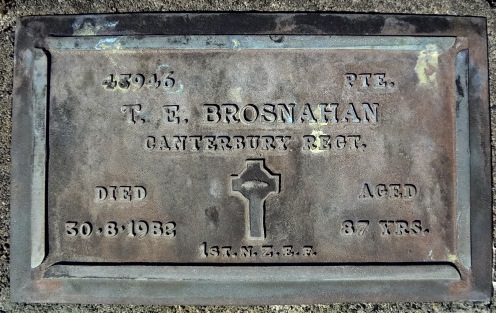
Timothy Edward Brosnahan died at Lower Hutt on 30 August 1982, aged 87 years. He was buried in the Soldiers’ section of Taita Lawn Cemetery, a services plaque marking his plot. “One of the last three links with the great Christchurch Marist Brothers senior rugby team of the early 1920s died this week in Wellington. Ted Brosnahan, who was 89, was full-back for that mighty side — a solid, reliable defender with a mighty kick which belied his 65kg, . . . . . . In common with many outstanding players in those days of first-class matches few and far between, Brosnahan had only three representative matches. All were in 1919 — both Canterbury’s games against Wellington and for the South Island against the North. He was also an obdurate batsman for East Christchurch, with a senior career stretching over 20 years, from 1915 to 1935. In those 151 matches, then a record for East, he scored 4152 runs at an average of 20.6, and hit three centuries. His eight first-class games brought him 281 runs at a similar average, with his best performance in his first match, at Hagley Oval against Otago. Going in at No. 3, Brosnahan batted nearly four hours for an unbeaten 73. . . . . . . . .” [Press, 1 September 1982.] “Ted Brosnahan, the cricketer-rugby player whose death at the age of 89 was noted in our columns this week, has another sporting claim to fame. In common with virtually all his Marist rugby club-mates in 1923, he switched to rugby league and earned representative honours in that code as well. He was full-back for South in the very first of interisland games, in 1925, when North won, 27-9; and for Canterbury against two outstanding touring teams. Canterbury lost, 47-10, to the 1924 Great Britain side; and 57-17 and 58-10 to the mighty 1925 Queensland team.” [Press, 3 September 1982.] Ted’s wife Mary Josephine died in 1992. His younger brother, Leo Patrick Joseph Brosnahan, also served in World War One, as did an uncle, William Joseph Brosnahan.
Sources
Auckland War Memorial Museum Cenotaph Database [08 February 2016]; N Z Defence Force Personnel Records (Archives NZ Ref. AABK 18805 W5530 0018547) [27 March 2016]; NZ BDM Indexes (Department of Internal Affairs) [08 February 2016]; Taita Lawn Cemetery burial record (Hutt City Council) [08 February 2016]; Taita Lawn Cemetery headstone image (Find A Grave per ancestry.com.au) [08 February 2016]; Temuka Leader, 1900, 1902, 27 December 1927, Press, 22 December 1904, 19 December 1906, 24 November 1916, 15 & 16 April 1918, 28 November 1923, 11 March 1927, 26 November 1928, 20 January 1930, 20 December 1933, 18 February 1935, 21 & 22 August 1950, 23 October 1957, 1 & 3 September 1982, Lyttelton Times, 16 December 1905, 6 January 1917, 9, 15 & 16 April 1918, 6 January 1919, Star, 24 November 1906, 5 December 1914, 17 July 1915, 26 February 1916, 24 October 1916, 9 April 1918, 22 October 1918, 11 March 1920, 11 March 1927, 26 November 1928, 21 January 1933, 20 February 1933, 18 February 1935, Timaru Herald, 27 November 1909, 9 November 1910, 6 March 1911, 28 February 1914, 16 April 1918, 31 August 1931, Waimate Daily Advertiser, 21 March 1910, Sun, 14 November 1914, 23 January 1915, 17 November 1915, 10 March 1916, 6 January 1919, 22 December 1919, 11 March 1920, Evening Post, 8 & 16 April 1918, NZ Times, 16 April 1918, 6 January 1919, Greymouth Evening Star, 19 August 1920 (Papers Past) [11 & 13 February 2016; 04 May 2023; 07, 11, 13, 14, 15 & 17 February 2026]; NZ Electoral Rolls (ancestry.com.au) [11 February 2026]
External Links
Related Documents
Researched and Written by
Teresa Scott, SC Genealogy Society
Currently Assigned to
TS
 Licensed under a Creative Commons Attribution-NonCommercial 4.0 International License unless otherwise stated.
Tell us more
Do you have information that could be added to this story? Or related images that you are happy to share? Submit them here!