STEVENSON, Charles Edward
(Service number 6/554)
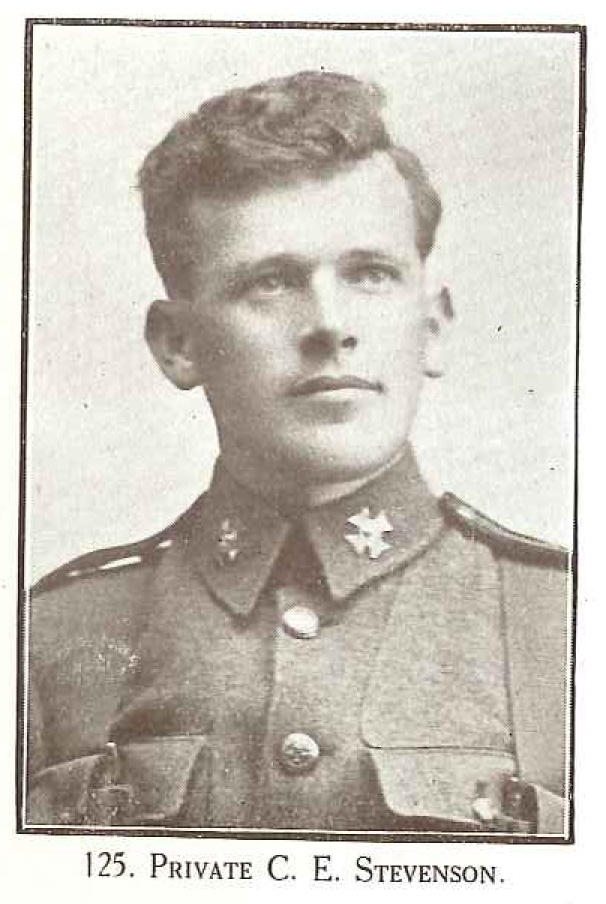
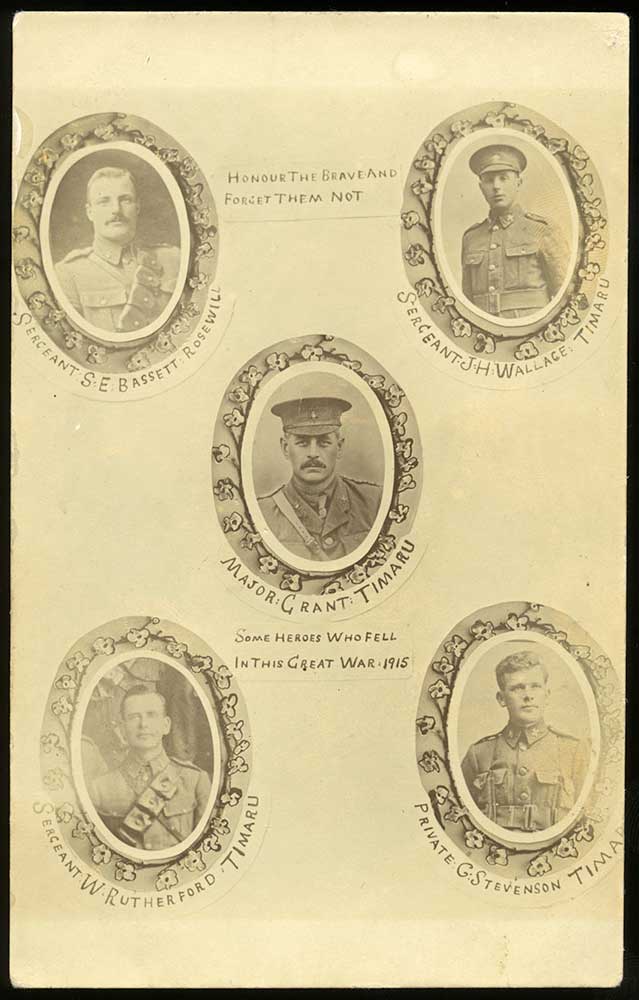
The postcard bears the slogan and title: "Honour the brave and forget them not" and "Some heroes who fell in this great war, 1915". The men pictured are Sergeant S E Bassett (Rosewill), Sergeant J H Wallace (Timaru), Major David Grant (Timaru), Sergeant W Rutherford (Timaru), and Private C Stevenson (Timaru) [Note it should be C not G Stevenson as it appears to read on the original] (South Canterbury Museum 4033)
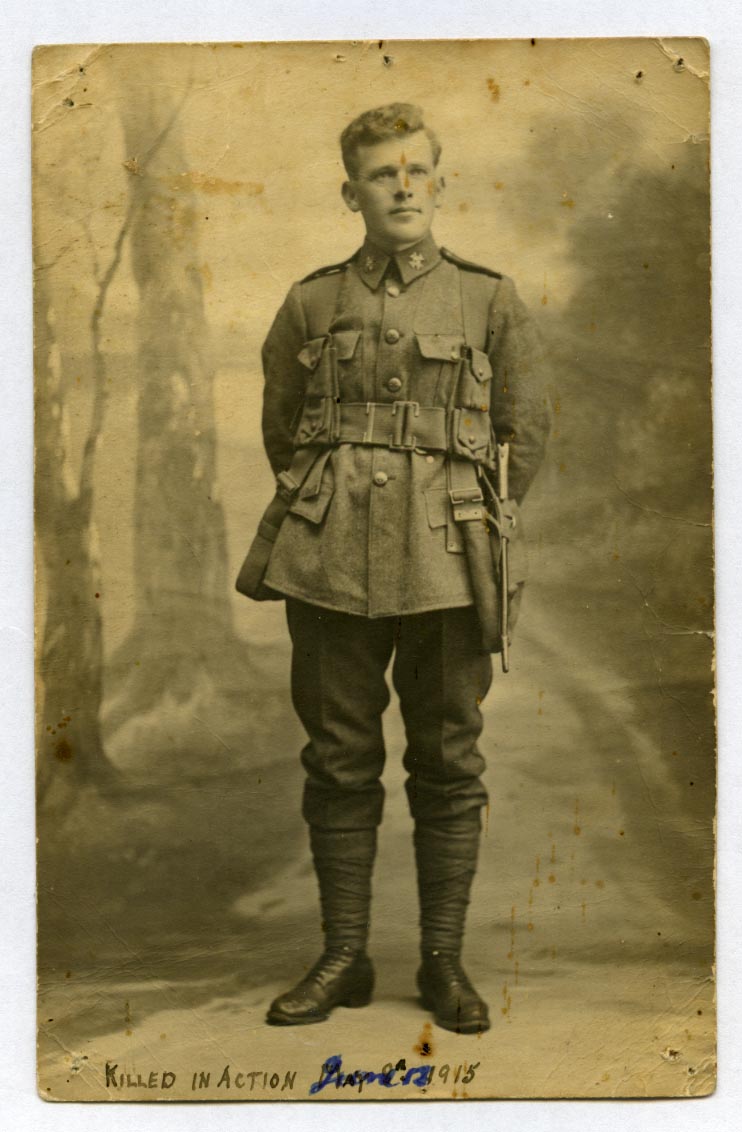
| First Rank | Private | Last Rank | Private |
|---|
Birth
| Date | 20 January 1888 | Place of Birth | Le Cren Street, Timaru |
|---|
Enlistment Information
| Date | 13 August 1914 | Age | 26 years 7 months |
|---|---|---|---|
| Address at Enlistment | P.O. Box 23, Fairlie | ||
| Occupation | Motor driver | ||
| Previous Military Experience | |||
| Marital Status | Single | ||
| Next of Kin | Miss Elizabeth STEVENSON (sister), York Street, Timaru | ||
Military Service
| Served with | NZ Armed Forces | Served in | Army |
|---|
Embarkation Information
| Body on Embarkation | Main Body | ||
|---|---|---|---|
| Unit, Squadron, or Ship | Canterbury Infantry Battalion | ||
| Date | 16 October 1914 | ||
| Transport | Tahiti or Athenic | ||
| Embarked From | Lyttelton, Canterbury | Destination | Suez, Egypt |
| Other Units Served With | |||
|---|---|---|---|
| Last Unit Served With | Canterbury Infantry Battalion | ||
Military Awards
| Campaigns | Balkans (Gallipoli) | ||
|---|---|---|---|
| Service Medals | 1914-15 Star; British War Medal; Victory Medal | ||
Award Circumstances and Date
No information
Prisoner of War Information
| Date of Capture | |
|---|---|
| Where Captured and by Whom | |
| Actions Prior to Capture | |
| PoW Serial Number | |
| PoW Camps | |
| Days Interned | |
| Liberation Date |
Death
| Date | 8 May 1915 | Age | 28 years |
|---|---|---|---|
| Place of Death | Dardanelles, Gallipoli, Turkey | ||
| Cause | Killed in action | ||
| Memorial or Cemetery | Twelve Tree Copse (New Zealand) Memorial, Twelve Tree Copse Cemetery, Helles, Turkey | ||
| New Zealand Memorials | Timaru War Memorial wall; Chalmers Church Honour Roll; Timaru Main School War Memorial; Fairlie War Memorial (C. Stevenson); Foresters’ Lodge Roll of Honour | ||
Biographical Notes
Charles Edward Stevenson, who was known as Charlie, was born on 20 January 1888 at Timaru, the youngest son of James Orr and Elizabeth (nee Kae) Stevenson, of York Street, Timaru. He was baptized at Trinity Presbyterian Church on 27 September 1888. James from Renfrewshire, Scotland and Elizabeth from Galashiels, Scotland married at First Church, Dunedin in September 1867. They had twelve children, the first two born at Oamaru, the next at Dunedin, and all thereafter at Timaru. Agnes was born in Dunedin and died at Timaru in April 1873 at 14 weeks; the twins (Isabella Julia and Matilda Augusta) born in 1882 both died in 1883, aged one year and 15 months respectively; Margaret Hannah died in 1887 at 7 weeks. Private Walter Stevenson, the fourth son, served with the Seventh Contingent in South Africa and was killed in action on 23 February 1902. Elizabeth (Charles’ mother) died at her Timaru residence (York Street) on 25 July 1898 after a long illness and before Charlie reached the age of ten; James Orr (his father) at the Timaru Hospital on 17 October 1907. Charlie’s father had taken a prominent part in volunteering and was one of the original members of the Garrison Band. Charlie was educated at Timaru Main School. There he did well, being awarded a boys’ prize in Standard IV in 1900, highly commended for drawing and a second-class certificate of merit in Standard V in 1901, and best of all, a first-class certificate of merit in standard VI in 1902. In addition, in 1902 Col.-Sergeant C. Stevenson was second in the Cadets 200 yards and won Major Crawshaw’s special prize for Drill Best Non-Commissioned Officer. By 1906 he was making his mark in football, representing the North End in their match against the South End on 17 May.
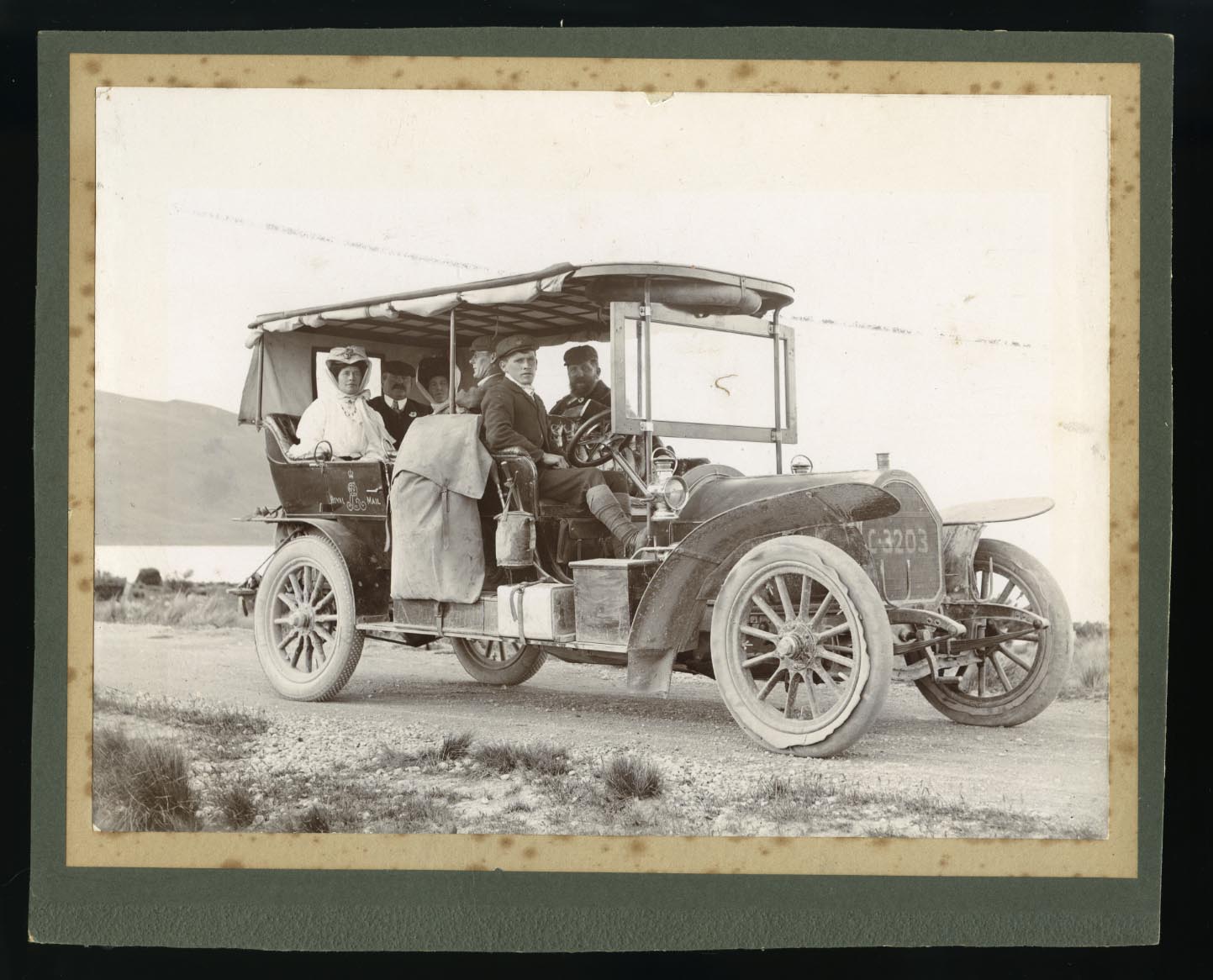
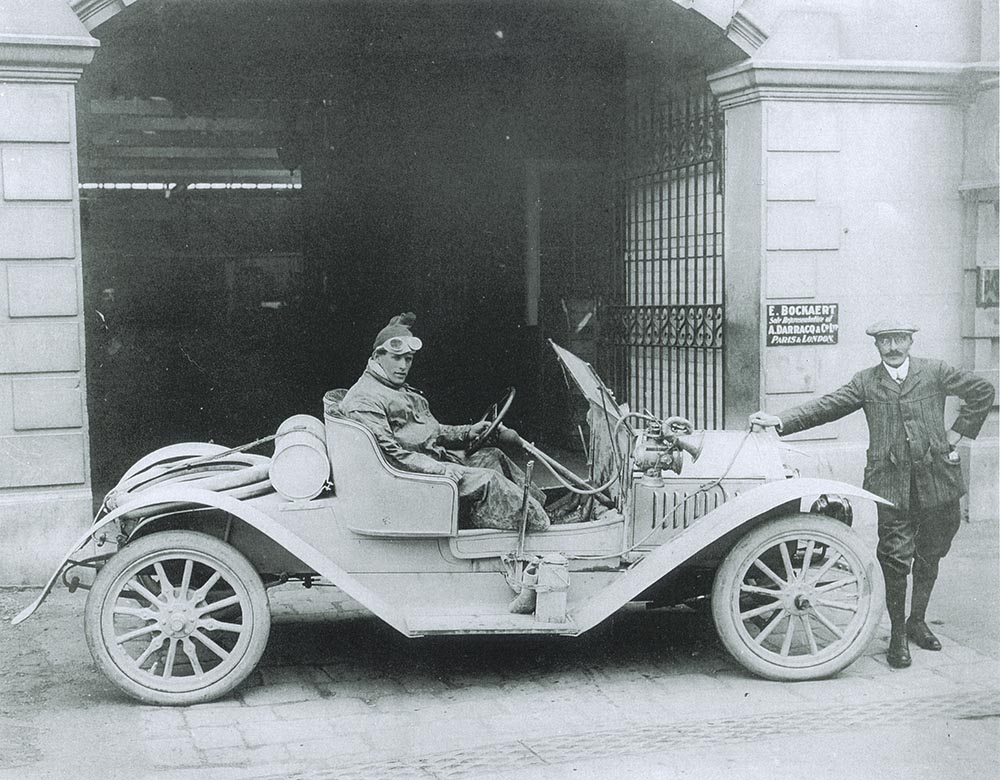
Stevenson established a world record for small cars driven by one man, by completing a phenomenal non-stop run of 740 miles from Invercargill to Christchurch and back to Invercargill then home to Timaru in a 14-16 horse-power Darracq on 7 March 1911. From this date he would have the distinction of being the world’s champion long distance driver. Charlie was toasted for his feat at a gathering in the Arcade Café, and farewelled before his intended departure for the Homeland, where he hoped to further his experience. He was presented with a fine gold watch in recognition of his meritorious performance, and with a photograph of himself in the Darracq. E. Bockaert, the Timaru agent for the Barracq, took advantage in advertising his product. His record run resulted in a visit to Sydney, where he met up with five other Timaru boys in September 1911, all “hale and hearty”. For several seasons Charlie drove a vehicle for the Mount Cook Car Company. In his work in the motor trade Charlie was described as enthusiastic yet of an unassuming nature. “He was a young man with a great future before him.” Sadly, his stamina and vitality, his determination, judgement, precision and skill would count for nil in the firing line.
At the time of enlistment Charlie was working at Fairlie as a motor driver for H. A. Le Cren. He had previously been employed in Bockaert’s motor-garage at Timaru. He was medically examined on 13 August 1914. Standing at 5 feet 6 inches and weighing 10 stone 1 pound, with a chest measurement of 35½-37½ inches, he had a fair complexion, grey eyes and brown hair. His sight was normal, his hearing and colour vision good, his limbs and chest well formed, his heart and lungs normal, and his teeth good. He was free from diseases, vaccinated, and in good bodily and mental health. He enlisted at Timaru on 13 August 1914, one of the first to answer the call, and joined the Canterbury Infantry Battalion. He was one of the additional men passed and sworn in on the night of 13 August. The next morning, 14 August, they were to fall in at the Drill Shed at 9.30 and leave Timaru at 1.30 for the camp at Addington. They were to be photographed prior to leaving. The Stipendiary Magistrate very kindly sent a big bundle of literature and some packs of playing cards for the use of the troops and another gentleman gave magazines, all of which were appreciated. Mr T. G. Towley, dentist, was also thanked for attending to the teeth of the men, free of charge, and doing all that was possible for all those whose teeth required attention. Charles named his eldest surviving sister as next-of-kin – Miss Elizabeth Stevenson, York Street, Timaru. The third infantry contingent actually left by the first express on 17 August after parading at the Drill Shed and being addressed by Archdeacon Jacob, who trusted God would guide and protect them, and the Deputy-Mayor (Mr W. A. Pearson), who said that all must “feel very proud to see that so many of the young men had volunteered to serve their country in this the greatest crisis they had ever known”, and he wished them God speed and a safe and speedy return. Private C. E. Stevenson was appointed to No. 6 Platoon, B Company (Second South Canterbury Regiment), under Captain D. Grant, at the central camp at Christchurch in mid-August 1914.
Private C. E. Stevenson embarked with the Canterbury Infantry Battalion, Main Body, departing from Lyttelton on 16 October 1914, and reaching Alexandria, Egypt on 3 December 1914. There was no more mention in the newspaper until he had been killed at the Dardanelles five months later (8 May 1915). The Otago and Canterbury Infantry Battalions suffered a big portion of the 2387 losses at the Dardanelles to this date. The lengthy newspaper lists received in June 1915 reported very heavy losses. Private Charles Edward Stevenson had been killed in action at the Dardanelles on 8 May 1915, aged 26 years. He is commemorated on the Twelve Tree Copse (New Zealand) Memorial, Turkey. Charlie's medals – 1914-1915 Star, British War Medal and Victory Medal - were sent to his sister, Miss Elizabeth M. Stevenson while his plaque and scroll were sent to his oldest brother James, both living in Timaru. Charlie executed a Will prior to leaving Christchurch in August 1914; he appointed his sister Elizabeth Merion (or Marion) Stevenson the sole executor and the sole beneficiary. A certificate of death had been forwarded to Elizabeth by the Adjutant General of the New Zealand Military Forces. Approximately £15 was to come from the NZ Military Forces.
Pte B. S. Graham, [Percy John] in a letter to his brother of York Street, noted that he was with Charlie Stevenson and Bill Wall when they were hit – “I can tell you that you have no idea what it is like here.” Of twelve in that party, four were killed (Oral Davey, Stevenson and Wall), and four wounded. The other four were the writer, Tom Smallridge, and two Temuka men. (Percy John Graham died of wounds on 6 December 1917 in Belgium.) At the July 1915 meeting of the Mackenzie County Council, it was observed that Charlie was well known in the Fairlie district and a message of sympathy was to be sent to his relatives. The name of Charles Edward Stevenson is recorded on the Timaru War Memorial, Chalmers Church Honour Roll, Timaru Main School War Memorial, the Fairlie War Memorial, and the Foresters’ Lodge Roll of Honour.
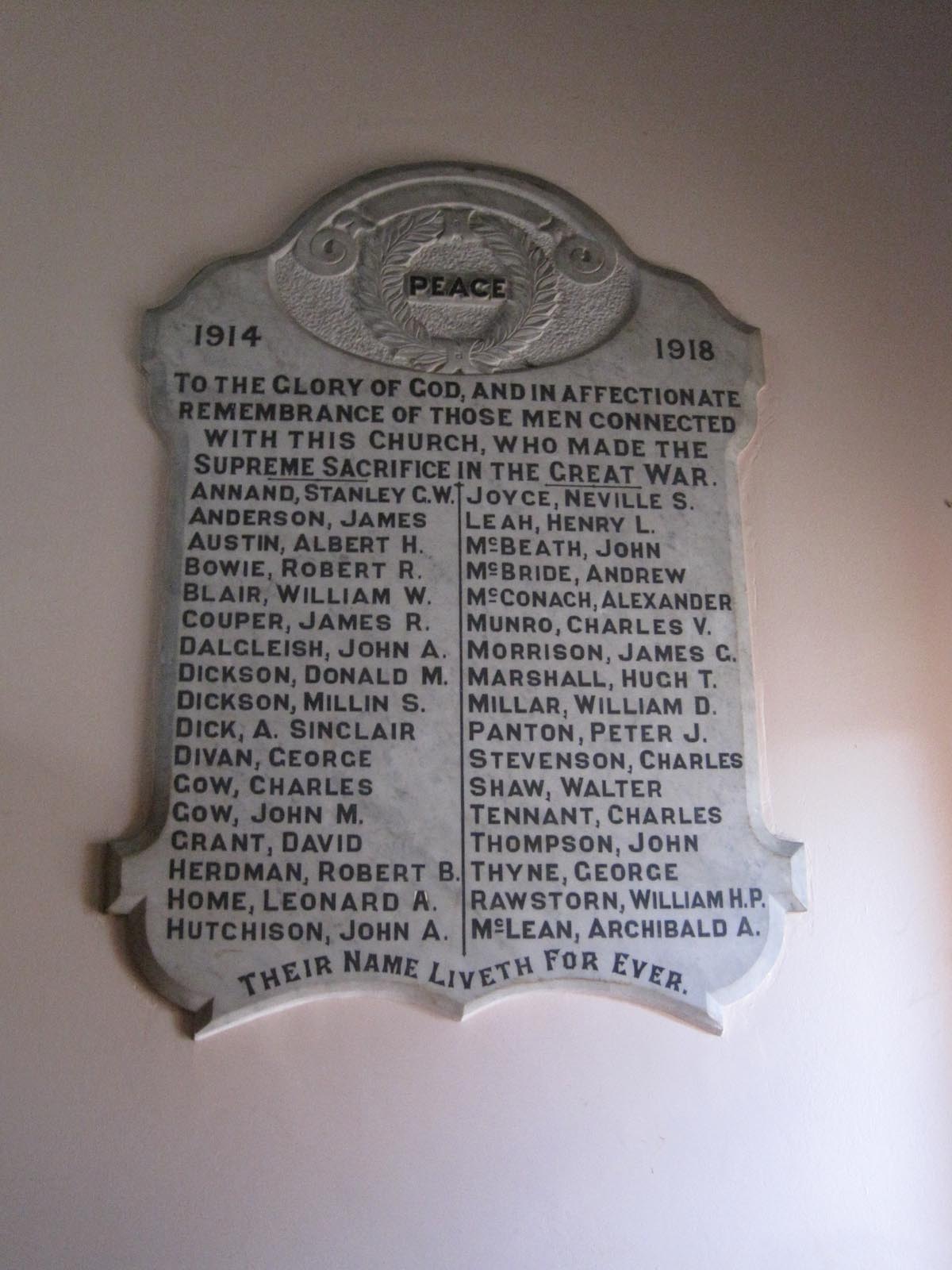
Charlie was a member of the Foresters’ Lodge. On 13 July 1920, the Lodge members unveiled in their hall a decorative Roll of Honour, which names 107 brethren who went to the front and underlines in red the names of sixteen who lost their lives. The name “C. E. Stevenson” is among those who made the supreme sacrifice. Beneath the inscription on the Chalmers Church memorial are some 34 names – PEACE 1914-1918 To the glory of God, and in affectionate remembrance of those men connected with this Church, who made the Supreme Sacrifice in the Great War. At the Timaru Main School, on Saturday, 25 June 1921, an important ceremony took place, when a very fine monument, standing in the school grounds at the corner of Arthur and Grey streets, was unveiled. The memorial is “a testimony to duty faithfully done, even unto death.” A beautiful wreath was placed on behalf of the school and the “Last Post” feelingly played. Nine days earlier the foundation stone for this memorial to the ex-pupils of the school who had lost their lives in the Great War, was laid. The Timaru Main School memorial is inscribed thus – In honoured memory of 70 ex pupils and teachers of the Timaru Main School who fell in the Great War and about 360 others who fought and returned 1914-1918 The Liberty we fought for use honourably. While no names are inscribed on the monument, scrolls bearing the names of the fallen ex-pupils (70) and of others who had served in the war (361) were inserted in the cavity of the foundation stone.
C. Stevenson is honoured on the Mackenzie District War Memorial at Fairlie. The original Mackenzie County War Memorial was unveiled on 16 December 1929. It has since been rebuilt. The parade, including the Timaru Municipal Band, 49 Returned Soldiers, the Executive Committee of the War Memorial, the Mackenzie Pipe Band, and School children from Mackenzie County Schools, formed up at the Post Office and marched to the site of the memorial. After the singing of the National Anthem, and a verse of the Canadian Anthem, the Chairman addressed the gathering, expressing gratification at the fact that at long last they were met to unveil and dedicate the memorial to the soldiers from the Mackenzie County who fell in the Great War. The design was unique in South Canterbury. It was not a cenotaph, or solely a monument of those buried elsewhere. It expressed more than that. It was a catafalque, a cairn upon which symbolically the remains of the Unknown Warrior were elevated, and were contained in the representation of a casket at the top of the structure. The base was composed of glacial boulders, and the shaft of limestone blocks. The whole erection was therefore constructed of indigenous stone. Thus, symbolically the Warrior rested on his native soil. The wreath above the tablet, composed of laurel leaves carved in stone symbolised victory. The tablet on which the names were inscribed is of marble. In a lengthy address, Father Barra, who had himself served as a chaplain, outlined clearly the campaigns throughout which New Zealanders had served, fought and died. They had “stood up in their splendid manhood, enthusiastically responding from the first to the call of their country.” He paid sensitive and abundant tribute to all involved in any role in the conflicts. An avenue of oak trees commemorating Fairlie’s fallen soldiers lines its main street.
The Stevenson family record was a good one. Charles’s brother Walter Stevenson was killed in action in 1902 in the South African War. His second eldest brother, John Stevenson, who took a prominent part in defence matters during the old volunteer days and followed a military career for many years, served within New Zealand in World War One. His brother William Frederick Stevenson was a freezing works foreman at Hastings when he was listed on the Reserve Rolls. His nephew, Frederick William Stevenson (son of James Stevenson), also served in World War One and was awarded the Military Medal and Bar. Two nephews are known to have served in World War One – Charles Walter Richard Stevenson (son of John) and Alfred John Stevenson (son of James). Lloyd Ansley Tait, a grandson of Charlie’s eldest brother James Stevenson, was killed in action in the Western Desert in 1941. John Watson, of Timaru, purchased a WWI Memorial Plaque in a second-hand shop. It was the Memorial Plaque sent to the relatives of Charles Edward Stevenson. Some considerable time after an article was printed in the Timaru Courier seeking descendants, a family member of one of Charles’ siblings claimed the plaque. A grandson of Charles’ oldest brother (James) started building a replica Darracq; after his unexpected death in 2016, his wife continued the project.
Sources
Auckland War Memorial Museum Cenotaph Database [16 March 2014]; NZ Defence Force Personnel Records (Archives NZ Ref. AABK18805 W5553 0109207) [23 April 2014]; CWGC [16 March 2014]; NZ BDM Indexes (Department of Internal Affairs) [13 August 2015]; Timaru Herald, 23 October 1907, 14 December 1900, 20 December 1901, 19 December 1902, 17 May 1906, 8 March 1911 [x 2], 9, 10, 11 & 13 March 1911, 14 March 1911 [x 2], 24 July 1911, 29 September 1911; 14 & 18 August 1914, 3 July 1915, 17 August 1915, 14 July 1920, 21 & 27 June 1921, 2 March 1928, 16 December 1929, Star, 12 & 14 June 1915, Press, 21 & 28 August 1914, 14 June 1915, 28 August 1915, New Zealand Herald, 14 June 1915, Lyttelton Times, 14 June 1914, Evening Star, 15 June 1915, Otago Witness, 30 June 1915, 14 July 1915 (Papers Past) [16 March 2014; 12 September 2014; 05 October 2014; 26 May 2015; 30 January 2020; 08 June 2020; 10 March 2022; 05 May 2022; 16 July 2023; 05 January 2026]; School Admission Records (South Canterbury Branch NZSG) [2014]; NZ Electoral Rolls (ancestry.com.au) [2014]; Will (Archives NZ & FamilySearch) [13 June 2014]; SCRoll web submission from I Barnett, 20 April 2015 (Quoting Poverty Bay Herald, Grey River Argus, Evening Post, 7 March 1911); Timaru Herald 13 March 1911; SCRoll submission by P Stevenson, 11 July 2018 (see SC Museum L2018/021); https://medalsreunitednz.co.nz [28 May 2019]; Presbyterian Baptism record (South Canterbury Museum) [09 January 2026]
External Links
Related Documents
Researched and Written by
Teresa Scott, SC Genealogy Society
Currently Assigned to
TS
 Licensed under a Creative Commons Attribution-NonCommercial 4.0 International License unless otherwise stated.
Tell us more
Do you have information that could be added to this story? Or related images that you are happy to share? Submit them here!