HAMILTON, Hubert Arthur
(Service number 7/592)
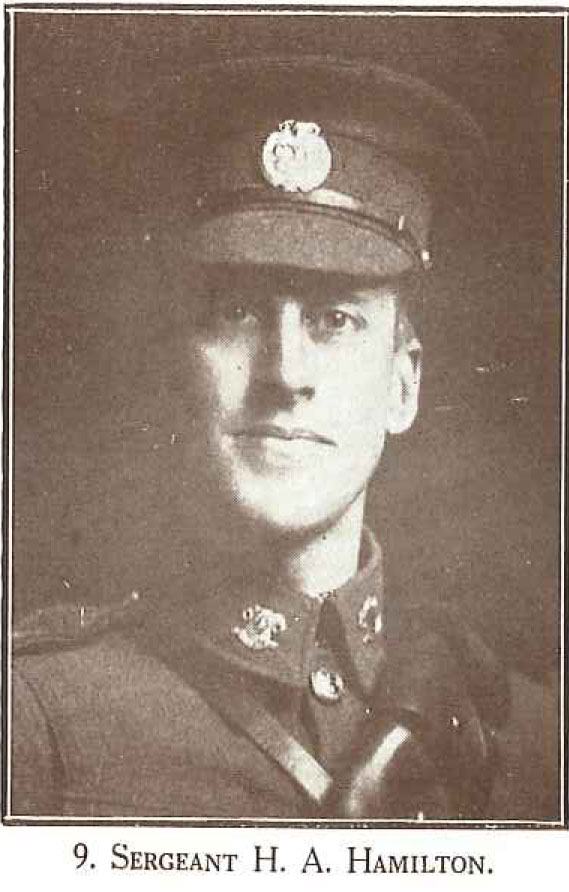
| First Rank | Trooper | Last Rank | Second Lieutenant |
|---|
Birth
| Date | 2 October 1887 | Place of Birth | Leeston, Canterbury |
|---|
Enlistment Information
| Date | 13 August 1914 | Age | 26 years 11 months |
|---|---|---|---|
| Address at Enlistment | "Gulladuff", Cave | ||
| Occupation | Farmer | ||
| Previous Military Experience | Volunteer Service only (Territorials) | ||
| Marital Status | Single | ||
| Next of Kin | Reverend Canon Staples HAMILTON, Vicarage, Geraldine | ||
Military Service
| Served with | New Zealand Armed Forces | Served in | Army |
|---|
Embarkation Information
| Body on Embarkation | Main Body | ||
|---|---|---|---|
| Unit, Squadron, or Ship | Canterbury Mounted Rifles | ||
| Date | 16 October 1914 | ||
| Transport | Athenic | ||
| Embarked From | Lyttelton, Canterbury | Destination | Suez, Egypt |
| Other Units Served With | |||
|---|---|---|---|
| Last Unit Served With | Canterbury Mounted Rifles | ||
Military Awards
| Campaigns | Balkan (Gallipoli) | ||
|---|---|---|---|
| Service Medals | 1914-1915 Star; British War Medal; Victory Medal | ||
Award Circumstances and Date
No information
Prisoner of War Information
| Date of Capture | |
|---|---|
| Where Captured and by Whom | |
| Actions Prior to Capture | |
| PoW Serial Number | |
| PoW Camps | |
| Days Interned | |
| Liberation Date |
Death
| Date | 22 August 1915 | Age | 27 years |
|---|---|---|---|
| Place of Death | Gallipoli, Turkey | ||
| Cause | Killed in action | ||
| Memorial or Cemetery | Hill 60 (New Zealand) Memorial, Hill 60 Cemetery, Turkey | ||
| New Zealand Memorials | Timaru War Memorial Wall; Geraldine War Memorial; St Mary's Anglican Church, Geraldine; Geraldine D.H.S. Roll of Honour | ||
Biographical Notes
Hubert Arthur Hamilton was the second son of the Rev. Canon Staples Hamilton, vicar of Geraldine, and his first wife, the late Rose Margaret nee Wylde. Born at the Leeston Vicarage on 2 October 1887, Hubert started school at Hokitika where the family lived for a time. He was next educated at the Geraldine Primary School, where in 1899 he was awarded the Standard IV prize for diligence and in 1900 a prize for drawing and class subjects, and at the Geraldine High School, where in 1902 he was recognized for Standard VII mathematics. In 1892 he had received a prize at St Mary’s Sunday School (Timaru). On leaving school he joined the Geraldine branch of the Post Office and was subsequently transferred to the Telegraph Department in Wellington. In Wellington he moved to the Bank of New South Wales, with which he was transferred to Ashburton. While living in Wellington, Hubert was successful in the civil service junior examination in December 1905, in the civil service examinations in January 1908, passing in five subjects, and in 1909 he passed the senior examination. Also in Wellington, he was a member of St Paul’s choir and secretary of St Paul’s branch of the Church of England Men’s Society. He also conducted side-shows in connection with the church’s annual sale of work. At a meeting in connection with the Girls’ Scouts, in May 1911 in Wellington, gratitude was conveyed to Mr. Hubert Hamlton who had been instructing the girls in the art of signalling. He undertook signalling with the Girl Peace Scouts, again in 1912. Mr Hubert Hamilton, who had devoted a great deal of time and patience to the instruction of the troops in semaphore signalling, received a commission as an instructor in October 1912. Hubert had been a pallbearer at the funeral of a local dignitary in Wellington in September 1911. It was in June 1913 that Hubert Hamilton joined the Ashburton Bank of New Zealand staff, after six months’ sick leave and severance from the Wellington staff. His health did not improve, however, and his friends became very anxious when he disappeared in July. He had called on the bank accountant asking fro a day off as he was feeling very unwell. On being alerted, the bank manager visited his room where he found a letter addressed to Hubert’s father (Rev. Canon S. Hamilton, of Geraldine). The police and other concerned people instituted searches near the river and in nearby areas. As his (Hubert’s) bools were in perfect order, it was believed that his strange disappearance was occasioned solely by ill-health. Fortunately, a telegram from Timaru was received in Ashburton, Hubert saying that he was staying in Timaru over-night with his brother who resided there.
Hubert had joined the Post and Telegraph Rifle Corps. When he enlisted on 13 August 1914, he was actually engaged in farming at “Gulladuff”, Cave, perhaps following a period of ill health while at Ashburton. He was medically examined on 25 September 1914. Standing at 5 feet 8 inches and weighing 142 pounds, with a chest measurement of 35-38½ inches, he had a fair complexion, blue eyes and fair hair. His sight, hearing, colour-vision, heart and lungs were all normal, his limbs and chest well formed. His teeth were in fair condition. He was free from diseases, vaccinated, And in good bodily and mental health. There was a mole between the index and middle fingers of his right hand. He had previously given Volunteer Service with the Territorials. Single and of Church of England affiliation, he named his father as next-of-kin - Reverend Canon Staples Hamilton, Vicarage, Geraldine. Hubert was accepted as a signaller. He was an expert signaller and was amongst the first to place his services at the disposal of the Empire.
Embarking at Lyttelton on 16 October 1914, on the "Athenic", Trooper H. A. Hamilton reached Egypt on 4 December of that year. In September 1914, he had completed a Short Course in Naval Signalling, in which he obtained a fair knowledge. He also passed Sergeants and 2nd class Signallers classes of instruction. In fact, Hubert was a signaller on the troopship “Athenic” on the way to Egypt. He was also a crack rifle shot. Hubert received a commission. His Parchment Commission was delivered to his father in June 1917, which must have been a cause for both pride and sorrow. On 20 August 1915 he was to be 2nd Lieutenant and was appointed Signalling Officer (N. Z. Gazette No. 143, 16th December 1915). This promotion was just two days before his death and only gazetted a few months later.
Hubert enlisted as a fit young man, eager for advancement, and was among some of the earliest to leave for the Front, only to lose his life in the following year at the Dardanelles. Just a month before his death, his father received a letter from Hubert in which he described in some detail the current rôle of his regiment - having a rest from the trenches, living in bivies only twenty yards behind the actual front, and shells bursting close by (here he mentions how Hamilton Elmslie, another Geraldine man, was wounded), and how after a quiet time, “things livened up a bit, and shot and shell flew thick”. He referred to the din during a service conducted on the previous Sunday morning; and to some fierce hand-to-hand fighting, with hand grenades. In conclusion, he wrote: “It's lots better than the Moving Pictures to sit outside my bivey and watch the enemy’s shrapnel bursting over and in the sea.” A short time later this Moving Picture scenario was no longer for Hubert. He was killed in action in the August Offensive, in which he was a leader. He was determined to break the stale mate by outflanking the Turks with a landing at Suvla Bay further to the north. To hold the enemy’s attention, he attacked at Cape Helles on August 6, sending 26,000 British men and 13.000 French soldiers against 40,000 Turks. British losses on the first day numbered 3,480; the Turks lost 7,510. By 22 August Allied troops losses surpassed 6,000 - among them Hubert Arthur Hamilton. He was one of 17 men of the Canterbury Mounted Rifles named in the casualty list issued on 14 September 1915. Hubert had many friends on the West Coast which he had visited in 1913.
Lieut. E. J. Hulbert, who was in charge of the Regimental Signallers, wrote: “Another ex-member of the Post and Telegraph Corps who died a soldier’s death is Sergt. H. A. Hamilton. An attack was to take place, and the artillery were pounding away, while officers and non-commissioned officers in charge of my various detachments were all ready for their duties. Sergt. Hamilton slipped away from his regiment (the C.M.R.) for a minute to ask me a final question. I put him right and wished him good luck as he moved off. He carried out his job all right, with no casualties in his detachment. Instead of remaining at his telephone, however, Hubert volunteered to go out and assist the wounded, and was killed while performing that duty. Just like Hubert, always ready to do more than his share. He was one of the keenest sergeants under my control, and had just been recommended by me for the position of Signalling Officer to the Wellington Mounted Rifles, which recommendation had been finally approved.”
Hubert was a general favourite in the Geraldine district and much respected, as shown by the expressions of sympathy conveyed to his father and family and the tributes paid - among them a resolution of sympathy passed in silence at a gathering of the Presbyterian Church, an expression of sympathy and gratitude from the Geraldine Literacy and Debating Society, and a motion of sympathy adopted in silence by the Geraldine Borough Council. Hubert's brother Gordon Cuthbert Hamilton and a half-brother Hugh Staples Hamilton, who left for the Front soon after advice of Hubert's death was received, also served in World War One. His oldest brother, Edwin Henry Staples Hamilton, was listed on the Reserves Roll. He was a cousin of Claude John Hamilton, of brothers Roy Grenville, Stephen Churchill and Thomas Geoffrey Hamilton, and of Frederic Carrington and Rodolph Edward Agassiz, all of whom served in World War I. At the meeting of the Wellington Accountant Students’ Society, held on 20 October 1915, the president read a letter regarding the heroic way Sergt. Hubert Hamilton an old member of the society, who was serving with the Mounted Signallers, met his death while assisting a wounded comrade. A resolution of sympathy to his relatives was carried by members rising silently to their feet. At the annual meeting of the Geraldine Lawn Tennis Club in October 1919, the names of Lieut. Hubert Hamilton and two others, members oi the Club who had given their lives for King and country, were placed on record.
On Anzac Day 1922 an exceptionally large number of people (estimated at 1500) gathered to attend the united service and to witness the unveiling ceremony of the memorial cross erected in grateful memory of the men of the Geraldine district who fell in the war. Following a march down Talbot Street, a very beautiful commenced with the Funeral March. Those gathered then joined the choir in singing the hymn “O God Our Help in Ages Past”. The Mayor, Mr E. Hardcastle, exhorted those gathered: “Let it be your duty then, so far as it lies in your power, to set the example of observing Anzac Day as not only sacred to the memory of the fallen, but one of thankful recognition of the great service they and their comrades did in the Great War to maintain your freedom and Liberty.” Sacred music, hymns, scripture reading, prayers, an address by the vicar, the organist’s playing of the “Dead March in Saul”, the bugler’s sounding of “The Last Post”, and a very touching rendition of the aria “I Know That My Redeemer Liveth” all complemented the service. Immediately following the service, the focus moved to the memorial – in the shape of a Celtic Cross and erected in honour of the soldiers who made the supreme sacrifice. Again an immense crowd assembled. The Mayor observed that all through the British Empire and in the Allied Countries there was the same tribute being paid to the memory of the fallen as that in Geraldine. The committee responsible for erecting the memorial decided that the names appearing on the cross should be those of men who gave their lives in the Great War and who had enlisted in the Geraldine and Mount Peel Ridings of the County, or whose next of kin resided in those districts. The men honoured on that day had left a “legacy of freedom, peace and plenty,” said Mr W. F. Evans of Temuka. After the singing of the National Anthem, Mr T. D. Burnett, M.P., said that the British Empire had always stood for liberty and justice, and he then unveiled the cross. A prayer of dedication was offered, a hymn was sung, the Territorials saluted and “The Last Post” was sounded. After an interval of silence, a piper played a lament and wreaths were placed around the memorial. The name of Sergt. H. A. Hamilton is recorded along with many familiar names, and accompanied by the inscription: “In Grateful Memory of the Men of the Geraldine District who fell in the Great War, 1914-1918. These gave up their own lives that others might live in freedom. Let those who come after see to it that their names be not forgotten.”
In late June 1924 at the Geraldine Parish Church (St Mary’s), where Hubert’s father was formerly vicar, a beautiful stained-glass window and a brass tablet, erected in memory of men of the parish and church who gave their lives for their country in the Great War, were unveiled by Archbishop Julius. Perhaps some relatives of H. A. Hamilton were in the congregation. After the dedication of the memorial, “The Last Post” was sounded and the National Anthem sung. The window features Christ as the King of Glory above a soldier dedicating his sword to God. The ceremony was “very earnest and impressive”, and the psalm and hymns of a comforting nature. The inscription on the brass tablet reads “To the Glory of God and in grateful remembrance of these our fellow churchmen of the Geraldine parish who gave their lives for their country in the Great War, 1914-1918, this window is dedicated.” The names follow, including that of H. A. Hamilton.
The name of H. Hamilton was heard again in October 1932 when the Diamond Jubilee of Geraldine School was celebrated. Prior to the concluding service, ex-pupils assembled at the Great War Memorial, where a wreath was deposited in honour of the ex-scholars who had made the supreme sacrifice in the Empire's hour of need. The secretary of the Geraldine Returned Soldiers' Association (Mr A. R. Hawke, a returned soldier) handed a beautiful wreath, inscribed “In Memory of Old Schoolmates — Lest We Forget,” to the Rev. Canon Coursey, who placed it at the foot of the Memorial, the ex-pupils standing in silence. “I dedicate this wreath,” said Canon Coursey, “to the . . . ex-pupils who laid down their lives during the Great War: — . . . . , H. Hamilton, [and others]. Let those who follow see that their names are not forgotten.” (Temuka Leader, 18 October 1932).
On 21 August 1916 in Christchurch Letters of Administration were granted in the estate of Hubert. Canon and Mrs Hamilton were bid farewell from Geraldine, for Christchurch, in August 1920, after 21 years of ministry there. Hubert has no known grave; rather he is commemorated on the Hill 60 (New Zealand) Memorial in Turkey. His name is inscribed on the Timaru War Memorial, the Geraldine War Memorial, and in St Mary’s Anglican Church, Geraldine. His name is recorded also on the Geraldine District High School Roll of Honour, beneath the inscription “We Will Remember Them”.
Sources
Auckland War Memorial Museum Cenotaph Database [08 October 2013]; NZ Defence Force Personnel Records (Archives NZ ref. AABK 18805 W5568 0135698) [18 December 2013]; CWGC [09 October 2013]; Timaru Herald, 20 June 1892, 26 December 1899, 17 December 1900, 23 December 1902, 24 July 1914, 26 July 1915, 15, 16, 18 & 23 September 1915, 8 October 1915, 1 September 1916, 23 April 1918, 7 August 1920, South Canterbury Times, 20 June 1892, 23 December 1899, , NZ Times,, 23 January 1906, 11 December 1915, Otago Daily Times, 14 February 1908, Evening Post, 13 February 1909, 29 October 1910, 22 May 1911, 15 September 1911, 21 October 1915, Dominion, 29 October 1910, 23 October 1915, Lyttelton Times, 13 July 1912, 19 October 1912, Ashburton Guardian, 23, 24 & 25 July 1913, 15 September 1915, Evening Star, 23 July 1913, Star, 23 July 1913, Temuka Leader, 18 August 1914, 9 October 1919, 27 April 1922, 18 October 1932, Press, 16 & 22 September 1915, 23 October 1915, 27 April 1922, 1 July 1924, New Zealand Herald, 15 September 1915, Greymouth Evening Star, 2 October 1915, Wanganui Chronicle, 11 December 1915 (Papers Past) [18 November 2013; 18 June 2014; 04 March 2015; 30 & 31 May 2015; 07 January 2016; 05 June 2016; 07 April 2018; 30 April 2019; 26 September 2021; 27 November 2025]; The August Offensive (Desert Column, http://desert-column.phpbb3now.com) [28 July 2013; 18 June 2014]; De Ruvigny's Roll of Honour, 1914-1919 (ancestry.com.au) [05 March 2015]; NZ BDM Indexes (Department of Internal Affairs) [2015]; NZ Electoral Rolls & Wise's P.O. Directory (ancestry.com.au) [30 May 2015]
External Links
Related Documents
No documents available.
Researched and Written by
Currently Assigned to
TS
 Licensed under a Creative Commons Attribution-NonCommercial 4.0 International License unless otherwise stated.
Tell us more
Do you have information that could be added to this story? Or related images that you are happy to share? Submit them here!