CAMPBELL, John Robert
(Service number 7/27)
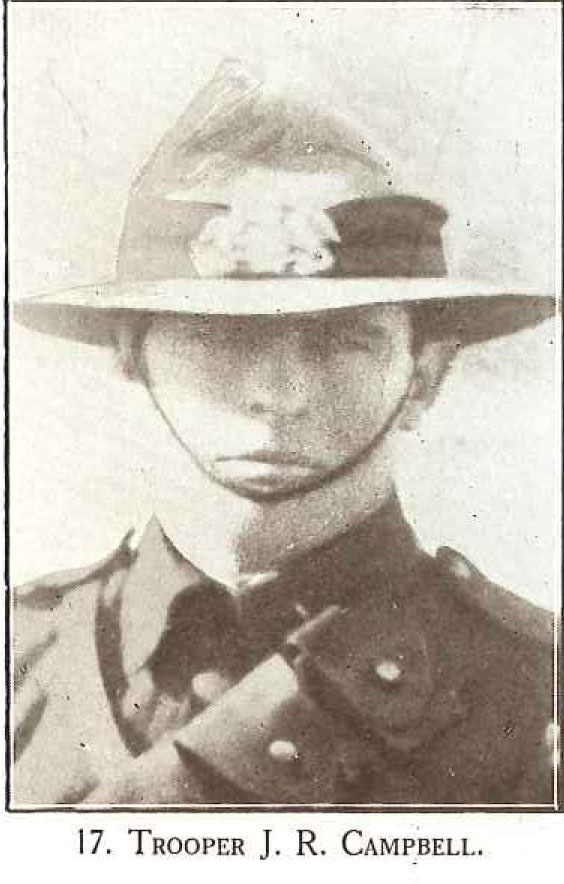
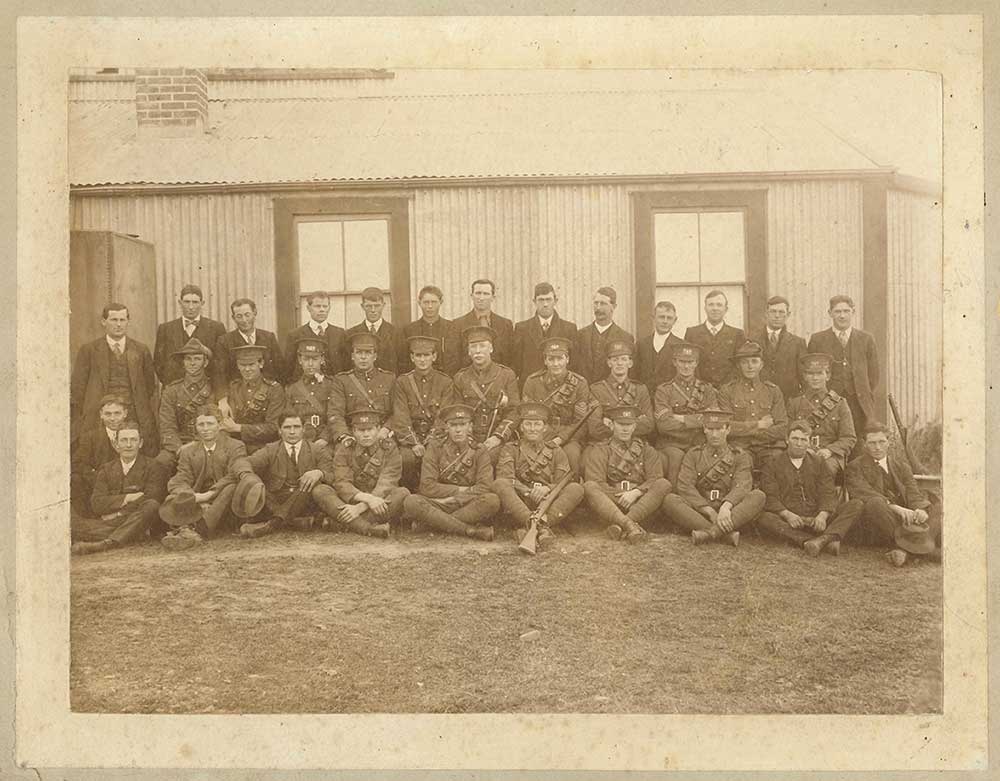
NB: Those names marked with an asterisk (*) were underlined in red as "killed or died of wounds". (Courtesy of R Waldie. South Canterbury Museum L2014/025.01)
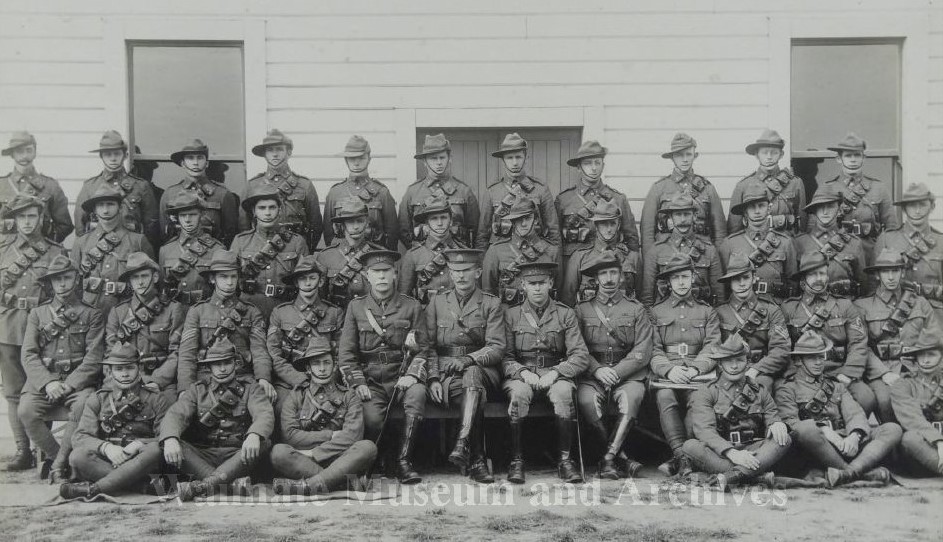
Back: Rainey, G; Frost, R; Julian, W; Cochrane, John; Tennant, John; Cochrane, James; Nichol N; Cameron, C; Robins; Rickman, E A; ?
3rd R: McKenzie, J (alexander John); Duggan, M; Tobin ,J; Tavendale, W; Campbell, J; Gynes; Hodgson, J; McKenzie, R S (Percy?); Samuels, H [actually Henry Samuel Miniss]; Copland; Fitzharris, P; Gill, J
2nd R: Fraser; Whitta, J H; Carr, J; Manchester, A R; Wain, P J; Finlay, John; Bailey, G C; Sloan, P; Bell, N; Menzies, W; Spencer, E; Ryan, E
Front: McGrath, W; Keane, T; Wall, T; Hunt; ?; Hogan, H (Courtesy of Waimate Museum & Archives, P2183 )
| First Rank | Trooper | Last Rank | Trooper |
|---|
Birth
| Date | 2 September 1891 | Place of Birth | Waimate |
|---|
Enlistment Information
| Date | 14 August 1914 | Age | 22 years 11 months |
|---|---|---|---|
| Address at Enlistment | Waimate | ||
| Occupation | Farmer | ||
| Previous Military Experience | Studholme Mounted Rifles - 18 months | ||
| Marital Status | Single | ||
| Next of Kin | Robert CAMPBELL (father), Waimate | ||
Military Service
| Served with | New Zealand Armed Forces | Served in | Army |
|---|
Embarkation Information
| Body on Embarkation | Main Body | ||
|---|---|---|---|
| Unit, Squadron, or Ship | Canterbury Mounted Rifles | ||
| Date | 16 October 1914 | ||
| Transport | Tahiti or Athenic | ||
| Embarked From | Lyttelton, Canterbury | Destination | Suez, Egypt |
| Other Units Served With | |||
|---|---|---|---|
| Last Unit Served With | Canterbury Mounted Rifles | ||
Military Awards
| Campaigns | Egyptian; Balkans (Gallipoli) | ||
|---|---|---|---|
| Service Medals | 1914-15 Star; British War Medal, Victory Medal | ||
Award Circumstances and Date
No information
Prisoner of War Information
| Date of Capture | |
|---|---|
| Where Captured and by Whom | |
| Actions Prior to Capture | |
| PoW Serial Number | |
| PoW Camps | |
| Days Interned | |
| Liberation Date |
Death
| Date | 30 June 1915 | Age | 23 years |
|---|---|---|---|
| Place of Death | At sea, on board HMHS Sicilia ex-Gallipoli | ||
| Cause | Died of wounds received in action. | ||
| Memorial or Cemetery | Lone Pine Memorial, Lone Pine Cemetery, Anzac, Turkey; Waimate Old Cemetery (memorial on parents' headstone) | ||
| New Zealand Memorials | Timaru Memorial Wall; Waimate War Memorial; Waituna War Memorial; Waituna Creek School Honour Roll. | ||
Biographical Notes
John Robert Campbell was the eldest son of a well-known family from Waituna, Waimate, South Canterbury. Sometimes known as Robert and also as Jack, he was born on 2 September 1891 at Waimate to Scottish-born Robert Campbell and his German-born wife Helena née Westphall, who was some twenty years younger than Robert. John’s schooling was at the local Waituna School, where his father was a member of the school committee. In December 1901 John and his brother James both got a mention at the Waituna School annual picnic and prize-giving, John being placed third in Standard III. After games, refreshments, the hosting of the recently acquired flag and the singing of a verse of the National Anthem, the prizes were awarded by the Rev. G. Barclay. Not long before the declaration of war Jack Campbell attended a euchre party and dance in aid of the Waituna School prize fund, where he a consolation euchre prize.
When John enlisted at Timaru in August 1914, he was farming for Mr Studholme at “Te Waimate”. He nominated his father as next-of-kin, was passed as fit, though of small build, and gave Presbyterian as his religion. One of the earliest men to offer his services in the war effort, John Robert Campbell departed with the South Canterbury Mounted Men by the slow train from Timaru on 17 August 1914, amidst much excitement in the town, whilst their horses were trucked at the Smithfield siding at Waimataitai. He had already given 18 months with the Studholme Mounted Rifles. The Mayor spoke of the pride in them and said that they were going forward with stout hearts and strong arms. "Be true lads to your King and Empire, to yourselves and your country, and put your trust in God," he said. Little did they know what lay ahead. Adept with horses, John handled nearly every horse put aboard the steamer at Lyttelton, when his regiment was embarking.
Although he saw only eight months of service, John Robert Campbell had opportunity to experience the inside of the barracks for committing some minor offences and incurring punishments on his Conduct Sheet – 3 February 1915, smoking on tables, 2 days confined to barracks; 18 March 1915, firing a round of ammunition during loading practice, 3 days confined to barracks; 19 March 1915, absent from Squadron limit whilst a defaulter, 4 days confined to barracks.
John Robert Campbell, 7/27 was admitted to the Hospital Ship “Sicilia” on 27 June 1915, with shell wounds to the shoulder, buttock, head and arm. He died there on 30 June 1915, succumbing to the wounds inflicted at the Dardanelles. John had been an orderly to Major Wain and he probably suffered his injuries on the same occasion as the Major did. Q.M.S. R. Manchester writing from a military hospital in Egypt to his mother at Waimate in July 1915, notes that Jack Campbell had been wounded by a shell and died on the boat. “They had to amputate his leg right at the trunk, and he didn’t get over it.” Lieutenant G. C. Dailey, in a letter written on 29 June 1915 to Mrs Tavendale, refers to the wounding of Jack Campbell in the shelling which killed William Tavendale.
The St Augustine’s Young Men’s Society, Waimate, held a mock banquet on 13 July 1915, at which a toast was proposed to “Our Boys at the Front”. By this time several of them had been wounded and one had given his life. Mr W. M. Hamilton who responded to the toast, had just received a letter from his son stating that Jack Campbell, in going out with provisions, had “bagged a sniper” on his way back. Those present at the banquet were unaware that Jack had in fact died. On 1 August 1915 a memorial service was held at Knox Church, Waimate, for Trooper Campbell and two other local servicemen who had laid down their lives for their country at the Dardanelles. The choir sang a special anthem. As John died intestate, his estate was administered by the Public Trustee, there being only £13.9.7 in Stock-in-trade to account for. His medals - 1914-15 Star, British War Medal and Victory Medal, plaque and scroll were all sent to his father in 1921.
At the annual meeting of the Waimate Caledonian Society on 29 September 1915, the members “who have offered their services and are so nobly upholding the honour of the British Empire and flag” were named. They included J. Campbell. “One of these, the late J. Campbell will not return to us. He has given his life in the defence of the Empire, and no one can possibly do more. We honour his memory and extend to his bereaved parents our deepest sympathy and our appreciation of the noble way in which their son carried out his duties to uphold the liberty and honour of our Empire.”
Trooper John Robert Campbell is commemorated on the Lone Pine Memorial at Anzac, Turkey, and his name is inscribed on the Timaru Memorial Wall, the Waimate and Waituna War Memorials, and the Waituna Creek School Honour Roll. His brother James Campbell died of wounds in France in 1917. Both Jack and his brother Jim are remembered on their parents’ headstone in the Waimate Cemetery, their father dying in 1924 and their mother in 1946. And in 1916, 1917, 1918, 1919, 1920 and 1921, an In Memoriam notice – For the Empire’s Cause, “He did his duty.” – was inserted variously in the Waimate Daily Advertiser, Otago Witness, Otago Daily Times by his parents, brothers and sisters. The name of Trooper J. R. Campbell also appeared under “Paid the Supreme Sacrifice” in the Roll of Honour published regularly in the Waimate Daily Advertiser.
On Arbour Day 1918, an impressive ceremony to honour fighting and fallen heroes was held at Waituna. After the Union Jack was hoisted by a senior pupil and the National Anthem sung, the school committee planted 26 oak trees in honour of ex-pupils of the school who had gone to the war. Addressing the gathering, the Mayor of Waimate quoted Kipling – “A soul goes out on the wind; and dies for England’s sake.” The planting of these trees would teach the children to come, in later years, that the sons of Waituna of to-day had taken a hand in this great war, and had been true to the character of the British people, he said. Another speaker eulogised the splendid nature of the memorial, observing that “the planting of the trees so closely indicated the happy idea that our lads were fighting shoulder to shoulder.” Special trees were selected and planted at the head of the line in memory of those who had fallen, and in every instance a relative was called upon to plant the tree, Robert Campbell planting the trees in memory of his sons. The Mayor declared each tree “well and truly laid”, and a card was attached to the tree with the name of the man it represented. Brass tablets were to be placed permanently at the foot of the trees of the six fallen soldiers – two of those being the Campbell brothers. Mrs Campbell was one of the ladies who liberally and ably assisted the Committee in a very successful day.
Another memorial tree planting was carried out at Woodlands in October 1919. The Mayor paid a high tribute to the fallen ones whom they were called together to honour that day. “The memory of their deeds would last forever and the tree they planted that day and the memorial to be erected later would serve as an emblem of their heroism.” Mrs Campbell and Mrs Stewart planted a tree in memory of John and James Campbell and Lochiel Stewart. Miss A. Campbell (sister) took a turn at the spade, as did children from Waituna School and others.
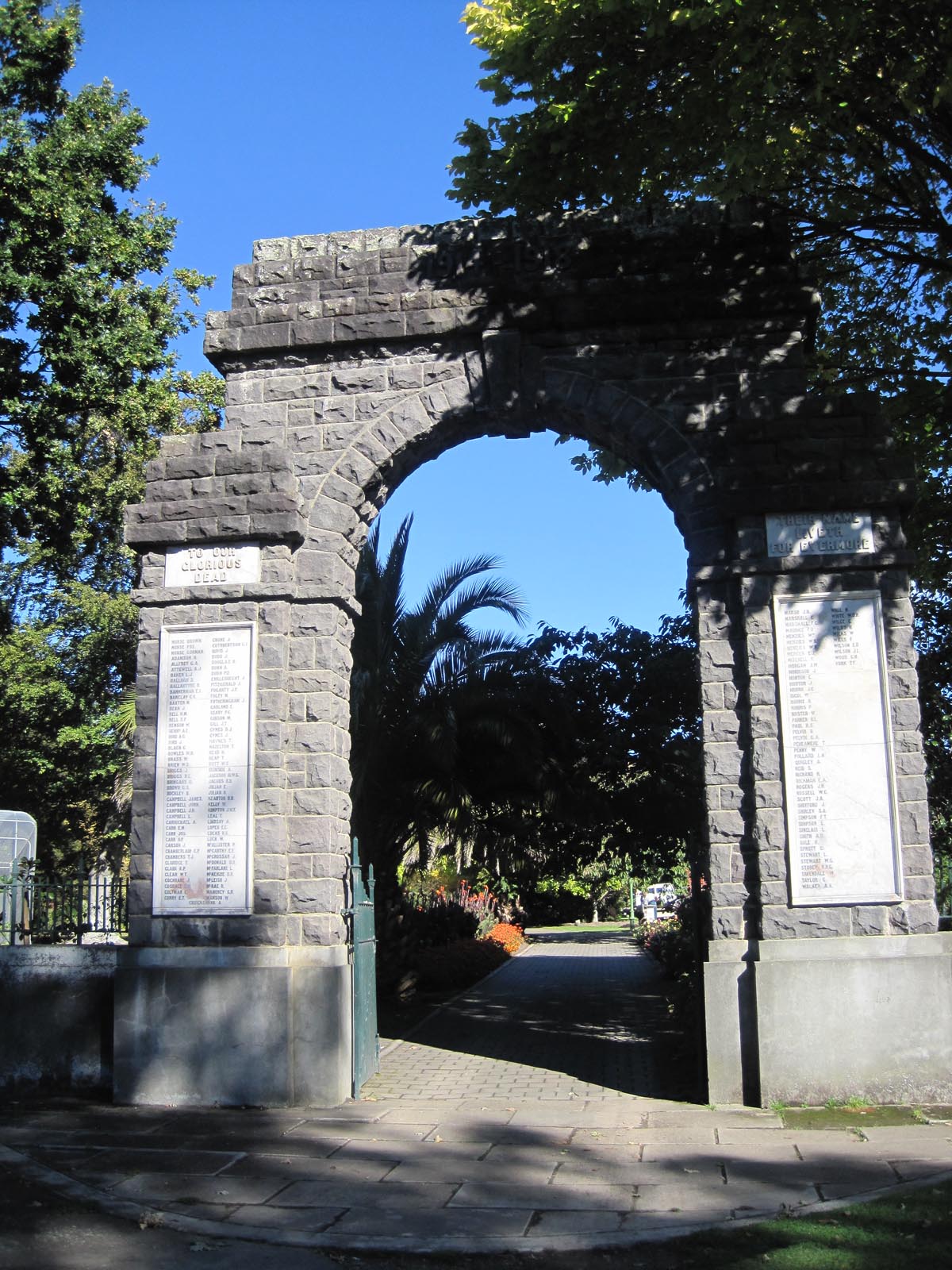
The Waimate War Memorial was unveiled following the Anzac Day service on 25 April 1923, the parade reforming to march to the park. Lieutenant-Colonel Newman Wilson, D.S.O., M.C., a Waimate man who served with distinction in the war, was invited to unveil the memorial. ‘Lieutenant-Colonel Wilson said that it was a matter for congratulation to the district and relations of those who are no longer with us that the splendid memorial had been erected. It was an outward expression of the high regard and esteem in which they held those who at the call of duty and danger did their job.
“We who are left behind,” he said, “feel that there is little we can do compared to those who gave their all. We must keep Anzac Day as a holy day and not as a holiday, not only must we tell them the brave story but also must we tell them of the awful cost — through the great sorrow we must learn wisdom.” In conclusion Colonel Wilson said he would repeat the last lines of Kipling’s Recessional Hymn:
Lord God of Hosts, be with us yet,
Lest we forget, lest we forget.
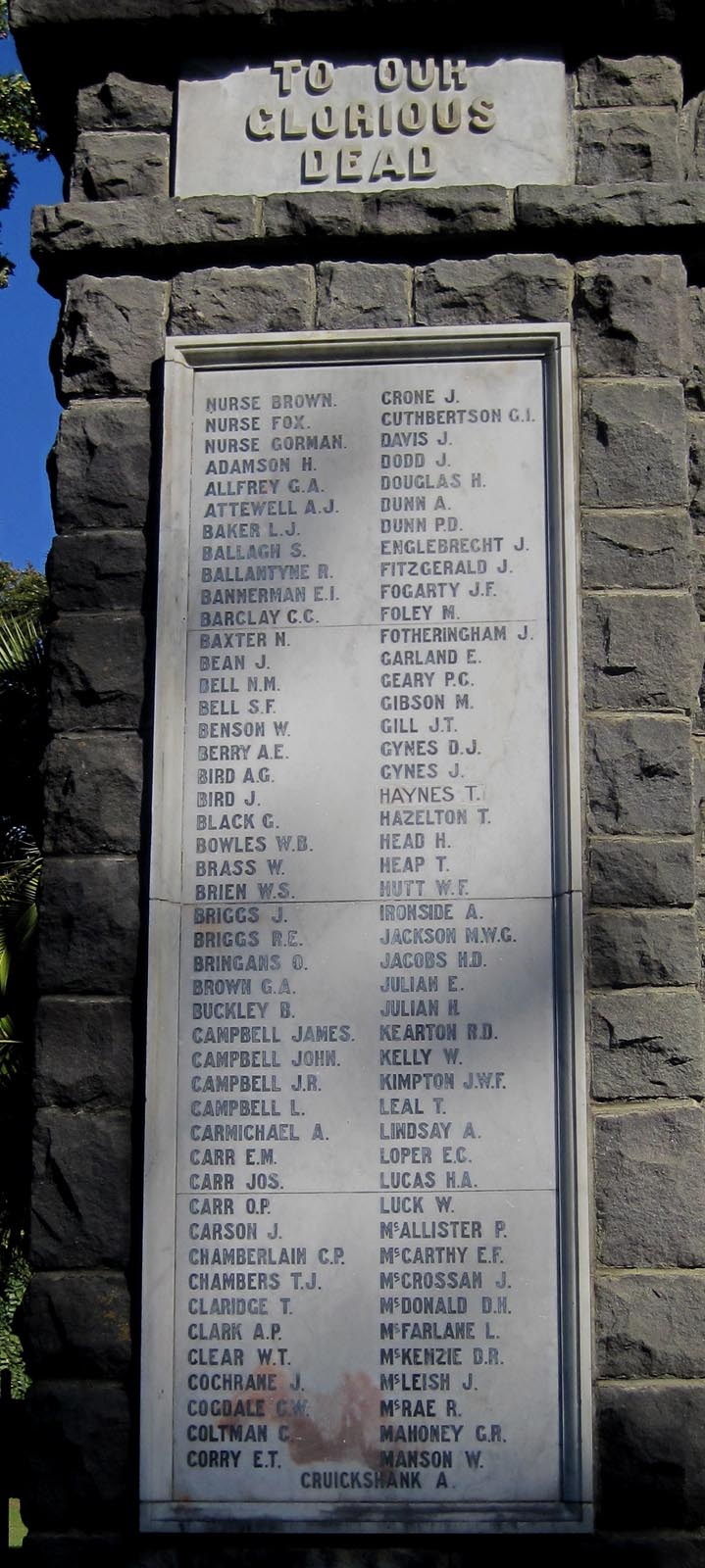
“I unveil this memorial to the glory of God and in honourable memory to those who gave their all for us and freedom.”’ A prayer of dedication, the firing of three volleys and the sounding of the “Last Post” followed, after which many beautiful wreaths were placed at the foot of the arch by returned men and relations of the fallen. The memorial which takes the form of a beautiful arch at Victoria Park records on marble tablets the names of those from the district who died in the Great War. Above the tablets is the inscription: “The glorious dead: the names liveth forever more.” Included among the names is J. R. Campbell.
Sources
Auckland War Memorial Museum Cenotaph Database [07 November 2013]; N Z Defence Force Personnel Records (Archives NZ Ref. AABK 18805 W5530 0022378) [08 November 2013]; CWGC [07 November 2013]; Timaru Herald, 27 April 1893, 18 August 1914, 16 & 17 July 1915, Waimate Daily Advertiser, 14 December 1901, 13 July 1914, 27 August 1914, 14 July 1915, 16 July 1915 [x 2], 31 July 1915, 21 & 25 August 1915, 30 September 1915, 20 April 1916, 30 June 1916, 21 May 1917, 30 June 1919, 25 October 1919, Press, 24 August 1914, 17 July 1915, Otago Daily Times, 16 July 1915, 30 June 1917, 29 June 1918, 3 August 1918, 30 June 1919, 30 June 1920, 30 June 1921, 10 October 1924, Otago Witness, 21 July 1915, 5 July 1916, 4 July 1917, 2 July 1919, Evening Post, 22 December 1917 (Papers Past) [22 December 2013; 25 March 2014; 11 July2014; 30 August 2014; 05, 06 & 07 July 2015; 30 June 2016; 20 December 2017; 01 & 02 January 2018; 01 November 2020]; Headstone transcription Waimate Cemetery (South Canterbury Branch NZSG Cemetery Records microfiche) [25 March 2014]; Burial record Waimate Cemetery (Waimate District Council) [25 March 2014]; Probate record (Archives NZ/FamilySearch) [10 May 2015]; NZ BDM Indexes (Department of Internal Affairs) [06 July 2015]; NZ Electoral rolls (ancestry.com.au) [06 July 2015]; Waimate Presbyterian marriage record (South Canterbury Museum) [07 July 2015]
External Links
Related Documents
Researched and Written by
Teresa Scott, SC branch NZSG
Currently Assigned to
TS
 Licensed under a Creative Commons Attribution-NonCommercial 4.0 International License unless otherwise stated.
Tell us more
Do you have information that could be added to this story? Or related images that you are happy to share? Submit them here!