KANE, James Augustus
(Service number 28889)
| First Rank | Private | Last Rank | Private |
|---|
Birth
| Date | 6 August 1892 | Place of Birth | Waikouaiti, Otago |
|---|
Enlistment Information
| Date | 29 June 1916 | Age | 25 years |
|---|---|---|---|
| Address at Enlistment | Club Hotel, Timaru | ||
| Occupation | Farm hand | ||
| Previous Military Experience | |||
| Marital Status | Single | ||
| Next of Kin | Peter KANE (father), Merton, Waikouaiti, Otago; later of Evansdale, Otago | ||
Military Service
| Served with | NZ Armed Forces | Served in | Army |
|---|
Embarkation Information
| Body on Embarkation | New Zealand Expeditionary Force | ||
|---|---|---|---|
| Unit, Squadron, or Ship | 18th Reinforcements, J Company | ||
| Date | 11 October 1916 | ||
| Transport | Tofua | ||
| Embarked From | Wellington | Destination | Plymouth, Devon, England |
| Other Units Served With | |||
|---|---|---|---|
| Last Unit Served With | Canterbury Infantry Regiment | ||
Military Awards
| Campaigns | Western European | ||
|---|---|---|---|
| Service Medals | British War Medal; Victory Medal | ||
Award Circumstances and Date
No information
Prisoner of War Information
| Date of Capture | |
|---|---|
| Where Captured and by Whom | |
| Actions Prior to Capture | |
| PoW Serial Number | |
| PoW Camps | |
| Days Interned | |
| Liberation Date |
Death
| Date | 14 November 1918 | Age | 25 years |
|---|---|---|---|
| Place of Death | Dunedin Hospital, Dunedin, Otago, New Zealand | ||
| Cause | Died of sickness - influenza & heart failure | ||
| Memorial or Cemetery | Hawksbury Cemetery, Waikouaiti, Otago | ||
| New Zealand Memorials | Merton War Memorial | ||
Biographical Notes
James Augustus Kane was born on 6 August 1892 at Waikouaiti, the seventh of the ten sons of Peter Kane and his second wife, Margaret née Mulholland, of Evansdale, Otago. Peter’s first wife, Julia Scully whom he had married at the Roman Catholic Cathedral, Dunedin in 1867, died in 1880. Peter and Margaret, both from Ireland, married at the Roman Catholic Cathedral, Dunedin in 1881. Peter was probably a sheep farmer at Fairview Farm, Beaconsfield, Waikouaiti, Margaret there with him in 1893. Peter had a large family of 14 sons and one or two daughters. Mr P. Kane was elected to the school committee at Merton in May 1895. It was Mr Kane of Merton who provided his barn for a welcome home to a local soldier returning in May 1902 from service in South Africa.
James enlisted at Trentham on 29 June 1916 after undergoing the medical examination at Timaru on 9 June when he registered. James was 5 feet 7 inches tall, weighed 158 pounds, and had a chest measurement of 33-36 inches, with a dark complexion, brown eyes and dark brown hair. His sight, hearing and colour vision were all good, his limbs and chest well formed, and his heart and lungs normal. He was free from diseases and in good bodily and mental health but was not vaccinated. He was working as a farm hand for Dr Bowe, of Maryburn, Fairlie, but gave his address as Club Hotel, Fairlie. Single and Roman Catholic, he named his father as next-of-kin – Peter Kane, Merton, Waikouaiti. Being compete, South Canterbury’s quota for the 18th Reinforcements left for Trentham on 28 June 1916. The men paraded at the Drill Shed in Timaru at 12.30, where they were addressed by the Mayor and Rev. Dean Tubman. They then boarded the first express north, disembarking at Temuka, where, in recognition of the splendid efforts of the Temuka district in all patriotic works and in compliance with a request from that district, they were farewelled by the Temuka residents. After a public welcome and farewell at the Temuka Drill Shed at 3 p.m., the recruits marched to the station, followed by the public. The businesspeople unanimously agreed to close their shops between 3 p.m. and 4.30 p.m.
He was inoculated at Featherston then vaccinated on 9 November after embarkation. It was with the 18th Reinforcements that Private J. A. Kane embarked, leaving from Wellington on 11 October 1916 per the “Tofua”. Disembarking at Plymouth, England on 29 December, he marched into Sling Camp, then proceeded overseas to France just over four weeks later and marched into Camp at Etaples. [1 Feb 1917] While serving – before, during and after overseas, James Kane incurred a few penalties. He lost 1 day’s pay for overstaying his leave by 2 days at Featheston. He forfeited 7 days ordinary pay for falling out of route march on 5 May 1917. At Quarantine Island, Port Chalmers on 25 July 1918, he disobeyed a lawful command given by his supervising officer, refusing to continue heavy fatigue (to wit, carrying material from wharf to building when so ordered). He was awarded 24 hours detention and forfeited 3 days’ pay.
He joined the 2nd Battalion, Canterbury Infantry Regiment in France on 3 June 1917. His time at the front was to be short-lived, however. Wounded in action at Ploegsteert, France on 6 August 1917, James was admitted to No. 3 New Zealand Field Ambulance, then to No. 2 Australian Casualty Clearing Station. He was next admitted to No. 26 General Hospital in France on 8 August 1917, having suffered gunshot wounds to his left leg and right arm. He embarked for England per “Stad Anterpen” on 14 August and was admitted to No. 2 New Zealand General Hospital at Walton on Thames Hospital the next day [15 August], with severe shrapnel wounds to his right arm and left leg. He was transferred to No. 1 New Zealand General Hospital at Brockenhurst on 26 August 1917, then to the New Zealand Convalescent Depot at Hornchurch on 2 October. The Medical Report prepared at the NZ General Hospital at Brockenhurst on 12 September noted – GSW (gunshot wound) to left thigh. (simple), GSW left leg (perforating), GS to right arm (perforating). Treatment was undertaken. The ulnar artery which had been severed resulting in paralysis was tied. At Brockenhurst the wounds were not healed except the one on the thigh; the one on the arm was very septic; the left leg was clean and healthy looking. It was recommended that Private J. A. Kane be sent ot New Zealand for discharge as physically unfit for active service. On 3 October 1917, he was classed unfit by the Medical Board and placed on the New Zealand Roll. Discharged from Hornchurch on leave on 2 November 1917, he was to report at Torquay on 19 November. James Kane embarked on 10 January 1918 at Plymouth for the return to New Zealand, per the “Arawa”, arriving in early March. He probably arrived at Dunedin by the north express on 7 March.
The Medical Board which had been assembled on the “Arawa” on 2 February 1918, noted that the gunshot wound to his right forearm had caused paralysis of his hand. It was caused by military duty; there was no progress; and discharge from the Expeditionary Force was recommended. No. 28889 Pte J. A. Kane was placed on the Syphilis Register at Quarantine on 24 June 1918, having a mottled rash on his chest and arms. His result at Dunedin on 2 August being negative, he was struck off the Register a week later. A Medical Board was assembled at Dunedin on 9 August. His original disability was twofold – (1) gunshot wounds to thigh and arm, (2) syphilis, the second due to causes existing prior to enlistment. It resulted in partial paralysis, and he was likely to be permanently unfit for both Active Service and territorial service, and probably Home Service. The Board recommended further treatment in a convalescent home at Dunedin under private arrangements at his own request for 28 days. It was recommended that he be not discharged from the army for six months but that he be given leave of absence without pay when his treatment for paralysis (GSW arm) would be finished; that he remain under observation and treatment; that he come before a medical board in six months’ time. He was medically boarded at Dunedin and issued with all necessary documents on 10 August 1918.
Sadly, before six months elapsed, Private James Augustine Kane died at Dunedin Hospital on 14 November 1918, aged 26 years. He was accorded a military funeral and buried at the Hawkesbury Cemetery, Waikouaiti, his grave marked by a services stone. With the influenza epidemic raging in Dunedin, the number of cases of influenza in the Dunedin Hospital was increased by half a dozen on 14 November, and James Kane was one of three patients who died on that day. James had not been discharged. His was a war death, commemorated by the Commonwealth War Graves Commission. His parents and his brothers Bernard and Hugh were later buried alongside. J. A. Kane’s name is engraved on the Merton Soldiers’ Memorial. Having decided to erect a memorial to the memory of the soldiers of the district who had fallen in the great war, the residents of Merton canvassed for funds. The result was a handsome obelisk erected in the local cemetery. The unveiling ceremony took place on 29 September 1920 in the presence of agood gathering of people. The “Last Post” was sounded and a number of appropriate speeches were made, before the ceremony closed with the singing of the National Anthem. A memorial notice – “For the Empire’s Cause” - was published in the Otago Daily Times on 13 November 2018 for James Kane as part of the newspaper’s First World War commemoration.
Three of his brothers also served in World War I – Hugh, Joseph Constantine and Daniel. Hugh embarked in October 1916. Joseph died at Timaru in 1977 and was buried in the Timaru Cemetery. Daniel, a farmer of Merton, who was called up in January 1917, appealed on the grounds of undue hardship. He had two brothers at the war (James and Hugh), one in Trentham (Joseph) and another who he thought would be going (Bernard?). Still another had been twice rejected (Sidney Martin?). He and a young brother of 19 were the only ones at home. He managed his mother’s farm, his father being over 80 years of age. There were ten members of his family of military age, and all single. He was given time. Thomas (half-brother) and Sidney Martin (called up in January 1917 as Martin Kane, farm labourer, Merton) also enlisted. Bernard Kane, farmer, Merton, was called up in early July 1917, and Frank Kane, farmer, Merton, was called up in April 1918. Frank said his father was 83 years of age, and he was the only one to look after 270 acres. Five sons had volunteered for serive, three of whom were now at the front. Bernard was unfit for service. He had two single brothers working for wages – one at Lake Tekapo and one at Nokomai. Another brother was in the C1 camp. The case was adjourned. A couple of months later, one brother at Home was in hospital, two had been wounded, one had returned wounded, and another had been rejected. Three other brothers had been classed C2. Conditional exemption was granted. Edward Michael Kane (half-brother), a rabbiter at Hanmer, was called up in 1916. In a death notice in the Timaru Herald, James was remembered as the brother of J. Kane, St Andrews and H. and A. Kane, Tekapo. These were John, a half-brother of James and the eldest of the family, and Henry and Anthony. James Kane’s medals – British War Medal and Victory Medal - were sent to his father, as were the plaque and scroll in 1924. Mr Peter Kane (senior) died at his Merton residence in September 1928, close to 100 years of age. He had enlisted for service in the Crimean War but was rejected. Margaret Kane, who was more than twenty years younger than her husband, died at Merton in July 1942. She made specific pecuniary bequests to six of her sons (Dan, Frank, Patrick, Joseph, Hugh and Barney) in her Will, and mentioned Harry but not Anthony who was still living and may have been a patient at Seaview, Hokitika. She was predeceased by James (1918) and Sidney (1918).
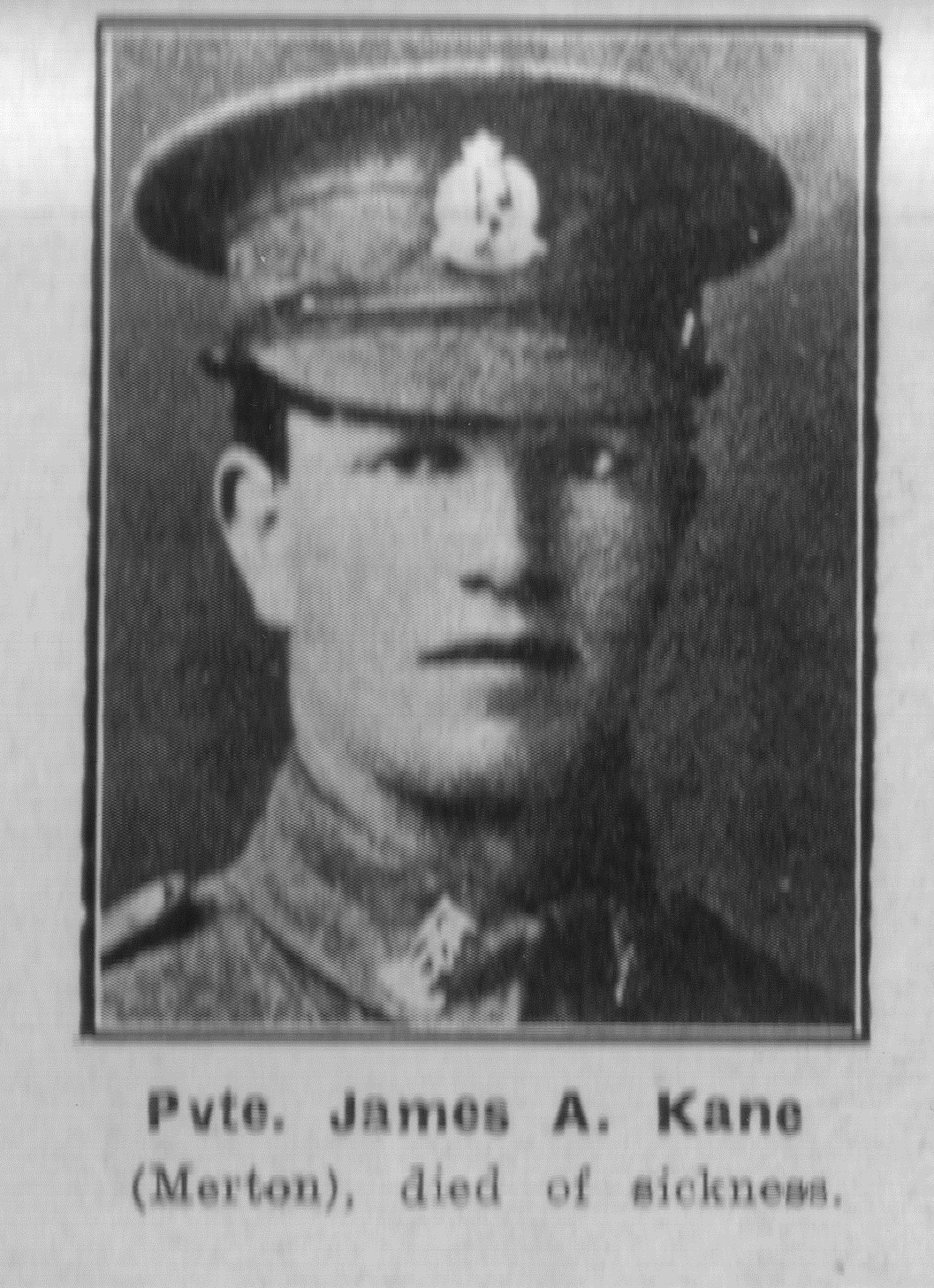
Two photographs of James A. Kane (Merton) were printed in the Otago Witness, one in August 1917 after he had been wounded, the second in December 1918 following his death of sickness.
Sources
Auckland War Memorial Museum Cenotaph Database [18 January 2016]; NZ Defence Force Personnel Records (Archives NZ ref. AABK 18805 W5541 0062460) [17 January 2016]; CWGC [17 January 2016]; Otago Witness, 9 May 1895, 29 August 1917, 25 December 1918, Otago Daily Times, 29 May 1902, 22 August 1917, 15 November 1918 [x 2], 23 November 1918, 5 October 1920, Timaru Herald, 10 & 27 June 1916, 16 November 1918, Sun, 21 August 1917, Evening Star, 22 August 1917 [x 2], 7 March 1918, 15 November 1918 [x 2], Evening Post, 22 August 1917, 19 November 1918, NZ Times, 22 August 1917, Oamaru Mail, 22 August 1917 Otago Witness, 13 March 1918, 20 November 1918, Dominion, 21 November 1918 (Papers Past) [17 & 18 January 2016; 14 July 2023; 15 July 2026]; Hawksbury Cemetery, Waikouaiti, headstone transcription (South Canterbury Branch NZSG cemetery records) [18 January 2016]
External Links
Related Documents
No documents available.
Researched and Written by
Teresa Scott, SC Genealogy Society
Currently Assigned to
TS
 Licensed under a Creative Commons Attribution-NonCommercial 4.0 International License unless otherwise stated.