WADE, John Corkill
(Service number 32572)
| First Rank | Sergeant | Last Rank | Sergeant |
|---|
Birth
| Date | 30 September 1888 | Place of Birth | Timaru |
|---|
Enlistment Information
| Date | 27 July 1916 | Age | 27 years |
|---|---|---|---|
| Address at Enlistment | Theodocia Street, Timaru | ||
| Occupation | Clerk (Queensland Insurance Company) | ||
| Previous Military Experience | |||
| Marital Status | Single | ||
| Next of Kin | Mrs Elizabeth WADE (mother), 48 Theodocia Street, Timaru | ||
Military Service
| Served with | NZ Armed Forces | Served in | Army |
|---|
Embarkation Information
| Body on Embarkation | New Zealand Rifle Brigade | ||
|---|---|---|---|
| Unit, Squadron, or Ship | Reinforcements G Company | ||
| Date | 12 February 1917 | ||
| Transport | Mokoia | ||
| Embarked From | Wellington | Destination | Plymouth, England |
| Other Units Served With | |||
|---|---|---|---|
| Last Unit Served With | New Zealand Rifle Brigade | ||
Military Awards
| Campaigns | Western European | ||
|---|---|---|---|
| Service Medals | British War Medal; Victory Medal | ||
Award Circumstances and Date
No information
Prisoner of War Information
| Date of Capture | |
|---|---|
| Where Captured and by Whom | |
| Actions Prior to Capture | |
| PoW Serial Number | |
| PoW Camps | |
| Days Interned | |
| Liberation Date |
Death
| Date | 26 July 1931 | Age | 42 years |
|---|---|---|---|
| Place of Death | Ewart Hospital, Wellington | ||
| Cause | Pulmonary tuberculosis | ||
| Memorial or Cemetery | Karori Crematorium, Wellington | ||
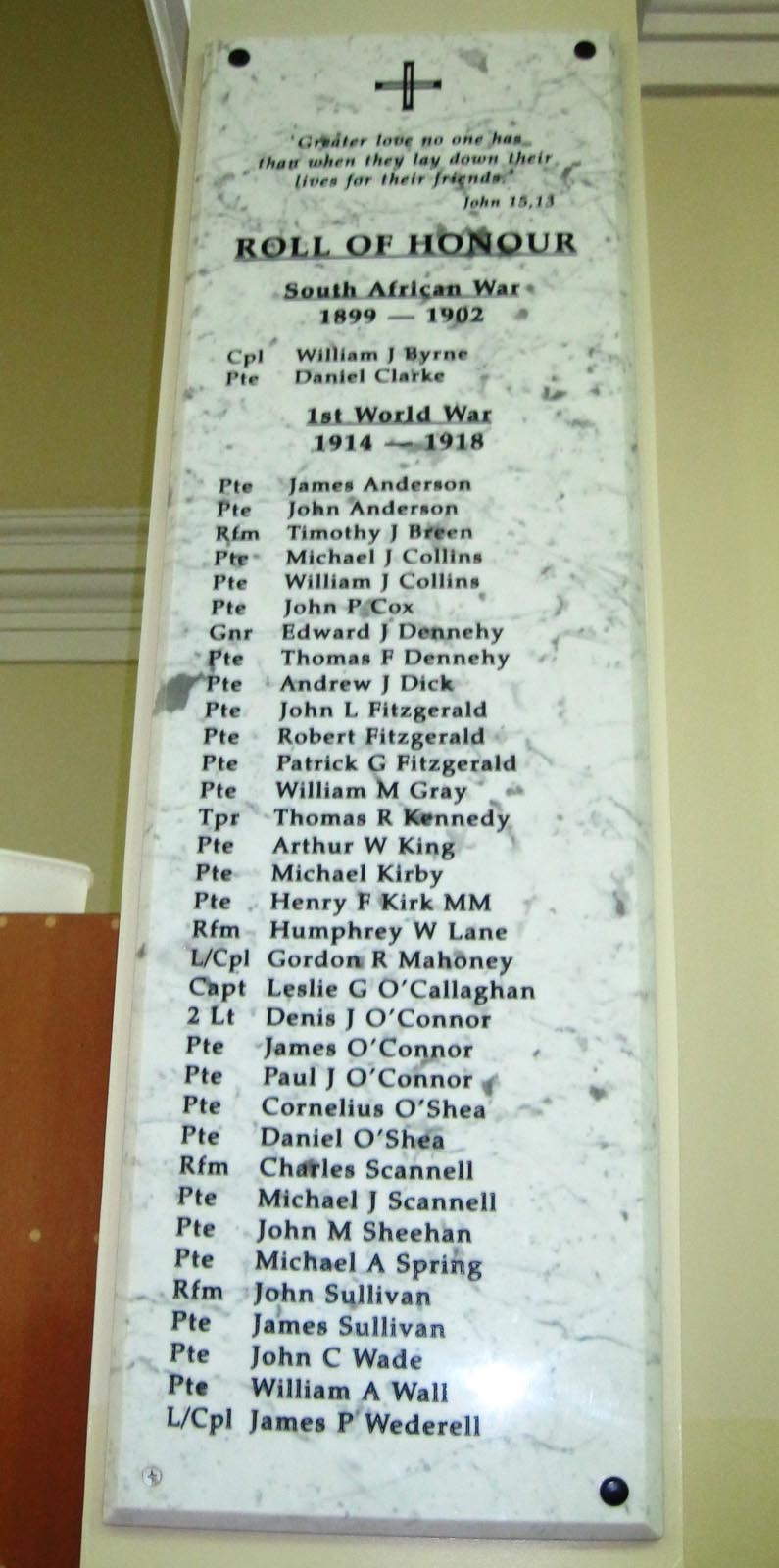
| New Zealand Memorials | Basilica of Sacred Heart, Timaru, Roll of Honour; Canterbury Fire Underwriters' Association Roll of Honour | ||
Biographical Notes
John Corkill Wade was born on 30 September 1888 at Timaru, the sixth child and second son of George William and Elizabeth (née O’Shea) Wade, and baptised Roman Catholic on 11 October 1888. George William Wade and Elizabeth (Bessie) O’Shea who married in 1879 had four daughters and three sons, six of the births registered at Timaru, that of John Corkill seemingly not registered. His birth date is confirmed by the baptism record. Daughter Alice Wade and son Robert Joseph Wade both died in infancy. George William Wade, a bootmaker, died on 16 February 1891. His funeral left his residence, Ellington Street, Attenborough for the Timaru Cemetery. Elizabeth who was left to bring up five children aged from 11 years to 2-year-old John, worked as a storekeeper, then as a boarding-house keeper. Mrs Wade started her storekeeping business in Elizabeth Street from subscriptions collected when her husband died. She had her struggles. In November 1897 part of her property was damaged by a neighbouring fire. She was adjudged bankrupt in August 1900. While the Wade girls were educated at the Sacred Heart School, John and his brother George attended the Marist Brothers School, where George received a prize in 1896. Master J. Wade did well in his recitation at the school entertainment in the Theatre Royal (in aid of the swimming bath fund) in early September 1900.
The Marist Brothers’ boys “seem to be keeping up their reputation in the football field”, reported the Tablet in August 1903. They had scored another victory by beating a team from the Oamaru Catholic Boys’ school on the Athletic grounds by 6 points to nil, J. Wade playing well and securing a try for Timaru. In June 1904 John represented the Marist Brothers in a match with Temuka District High School, scoring a try in their winning effort. John was the half-back when teams representing the Timaru and Christchurch Marist Brothers’ Schools met in a game of football in September 1904. He played a brilliant game, his passing being very accurate, and was instrumental in securing a convincing win for Timaru over the Christchurch team which had a very good reputation at home. He kept up his football throughout the years following, often prominent in play. From 1906 it was Celtic he played for, representing the club on the seven-a-side tourney in June. John C. Wade was the first secretary of the Celtic Football Club when it was formed in 1906. He also represented the club in its first competition match. The newly formed Celtic Football Club made an excellent start for the President’s Trophy yesterday [3 May 1906] when they opened their scoring book and defeated a High School team. Of the backs E. Sullivan and J. Wade were most prominent. In 1906 the team for the President’s Trophy finished runners-up, winning 10 matches, drawing 3 and losing 1. The first advertisement for the Celtic Football Club appeared in the Timaru Herald of 18 August 1906 above the name of J. C Wade, Hon. Sec. Notice of a special meeting of the Timaru Celtic Football Club appeared above his name in November 1906. He also captained the team in 1906. J. C. Wade was still the hon. Sec. when notice of the second annual meeting was given in February 1907. He was duly re-elected secretary (and treasurer) and filled that position until 1908. In July 1909, J. Wade (Celtic) was chosen to play half in a representative game. In 1914, while still secretary of the Celtic Club, J. Wade was playing for Pirates (at half). At the committee meeting of the South Canterbury Rugby Union in July, J. Wade attended to explain a claim by the Celtic Club that Waade owed them £1 2s for subscriptions in arrears. “The Celtic secretary explained that the claim covered from 1906 to 1914 inclusive, except the year 1909, when the subscription for that year was paid. He had since paid for 1906, 1907 and 1908. Wade said he was secretary for 1906, 1907 and 1908, but did not think a secretary was expected to pay a. subscription. He paid his subscription in 1909 and 1910, and played for Celtic in those years. Fo, 1911-12-13 he did not play for Celtic. He had paid for 1906, 1907, 1908 and 1910. It was decided that Wade was not liable for his subscription for the years 1911 to 1914 inclusive.” Wade played well for Pirates, too, playing “a game entirely out of the box” later in July 1914.
In September 1905, a boys’ club (twenty-one years and younger, not attending school) was started in connection with the church at Timaru, and its early success not only fully justified its existence but was full of hope for the future. “The boys are taken in hand as they leave school, and every encouragement is given them to keep up the practices of their holy faith. As set forth in its rules, its object is for the healthy enjoyment and mental improvement of its members, and to encourage them in the practice of their religion.” As of May 1906, Master J. Wade was the treasurer. He was a member of the committee in September when the name “Timaru Catholic Young Men’s Club” was decided upon. The address which was presented to Bishop Grimes when he visited the Timaru parish in June 1908, was signed for the Celtic Club by the president Rev. Father le Floch and the secretary J. C. Wade. Later in the month Mr J. Wade was one of the chief speakers in the debate arranged by the Catholic Young Men’s Club – “What is the best form of sport for the full development of the brain and muscle?” He was elected to the committee in March 1909 when it was decided to form a men’s social club named the Timaru Catholic Club. In the comedy “My Lord in Livery”, presented by the Young Men’s Society in August 1909, Mr J. Wade took the part of the young lord. “Mr Wade starred for the first time with admirable sang froid; word perfect and with a good conception of the character impersonated, he was an undoubted success. His newness was only observable in his gestures caused by a tendency to overdo in this instance, the nautical swing.” In July 1912 he gave a recitation at the farewell function for one of the teaching brothers in the Marist Brother’s School.
J. Wade gained a Junior 2nd class pass in Commercial English in the examinations held at the end of the 1913 session (October) of the Timaru Technical School. John C. Wade was an insurance agent for the Queensland office in Timaru. He, his older brother and two of his sisters lived at home with their widowed mother. John Corkill Wade was medically examined at Timaru on 20 May 1916. He was 5 feet 6 inches tall and weighed 134 pounds, with a chest measurement of 32½-35 inches, a dark complexion, grey eyes and black hair. The sight in his right eye measured 6, his left eye 18. His hearing and colour vision were good, his limbs and chest well formed, and his heart and lungs normal. He was free from all diseases, vaccinated, and in good bodily and mental health. Residing at home with his widowed mother, single and Roman Catholic, he named his mother as next-of-kin – Mrs Elizabeth Wade, 48 Theodocia Street, Timaru.
South Canterbury’s quota for the Nineteenth Reinforcements left for camp on 26 July 1916. The South Canterbury military district was congratulated on being able to send forward a full quota, which included four Non-Commissioned Officers for the 21st Reinforcements, one of them J. C. Wade. A civic farewell took place – luncheon in Stafford Tea Rooms and speeches at the Drill Shed. John was a clerk for the Queensland Insurance Company at Timaru when he enlisted on 27 July 1916 at Trentham. Corporal J. C. Wade was posted to the Non-Commissioned Officers of the 21st Infantry Reinforcements at Trentham, then transferred to the 22nd Reinforcements on 5 September. He was promoted to the rank of Sergeant on 16 October 1916, when he returned to Trentham after spending his leave in Timaru. Sergeant J. C. Wade embarked with the New Zealand Rifle Brigade, departing from Wellington per the “Mokoia” (Transport No. 77) on 12 February 1917 and disembarking at Plymouth or Devonport, England on 2 May. On the outward trip he spent five days (5 April 1917 – 9 April 1917) in the Ship’s Hospital with a dislocated toe.
On 2 May 1917 with the New Zealand Rifle Brigade at Sling, he reverted to the rank of Temporary Corporal. He was, however, taken on Strength as Sergeant. On 1 June 1917 at Sling, he was confirmed in the Rank of Sergeant having qualified as very good in a recent exam. Proceeding overseas to France on 6 June 1917, he marched in at Etaples two days later. Marching out on 25 June, he joined his Battalion in the Field the next day. On 10 June 1917 while at Etaples, John Wade had been severely reprimanded for entering a café when on duty. Just ten weeks elapsed before he went to hospital, sick with myalgia (4 September 1917), admitted firstly to No. 233 Field Ambulance, then to No. 41 Casualty Clearing Station, and on 8 September to No. 26 General Hospital at Etaples in a grave condition.
Embarking for England per hospital ship on 15 September 1917, Wade was admitted to Walton-on-Thames Hospital or the No.1 New Zealand General Hospital at Brockenhurst. He was severely sick with polyarthritis (rheumatism in several joints). He was classed unfit by a/the Medical Board on 11 November 1917. John C. Wade returned to New Zealand per the Hospital Ship “Maheno” with invalided soldiers, embarking at Avonmouth on 24 December 1917 and arriving on 31 January 1918. He was discharged on 21 June 1918, no longer physically fit for war service on account of illness contracted on active service (Rheumatic Fever), and for his service in Western Europe he was awarded the British War Medal and the Victory Medal. He returned home to Theodocia Street but perhaps went soon to Christchurch. To the Sanatorium? A clerk at Cashmere in 1922, he moved to Wellington in about 1925.
A roll of honour of members of the Canterbury Fire Underwriters’ Association, who served in the late war was unveiled at the Chamber of Commerce in Christchurch on 23 March 1921, by the chairman of the Fire Underwriters’ Association. Those present stood in silence for a few seconds in memory of the dead. The roll is in the form of four panels of light oak with names inscribed in gold. The names on the board, with those of the dead asterisked, include J. C. Wade (Queensland Insurance Co.). The annual smoking concert of the staffs of the Insurance Companies doing business in Christchurch took place at Freeman’s' Cafe on 24 July 1922 and was largely attended. The toast to “Our Chiefs” was proposed by Mr J. C. Wade, who referred to the good fellowship which existed between the chiefs in the various insurance offices of the city and their staffs. He considered that amongst the insurance people in Christchurch there was harmony, good fellowship and good comradeship. The companies’ guild was an evidence of this good comradeship. The guild had done a great deal to secure better wages for the insurance staffs. The demands made by the guild had not been unreasonable, and they had been met in almost every case. He thanked the chiefs for the concessions they had granted their staffs at various times. He made an excellent humorous speech and gave some laughable Limericks, taking off some of the notabilities in the local insurance world. When a meeting of the Council of the Canterbury Automobile Association was held on 4 December 1922, J. C. Wade was elected a new member. In April 1924, Mr J. C. Wade was on the staff of Mr F Molloy, a solicitor in Timaru, when he received advice that he had been successful in passing in subjects sat for at the Law examinations (Evidence and Procedure), held in Christchurch.
Mr John Corkill Wade married Miss Myrtle Evelyn Redpath on 23 November 1926, a quiet wedding taking place at the Kelburn Presbyterian Church, Wellington. John Corkill Wade died of pulmonary tuberculosis at Ewart Hospital, Wellington on 26 July 1931, aged 42 years. He was cremated at Karori on 31 July, his ashes scattered. His next-of-kin was his wife – Mrs Myrtle E. Wade, 85 Rodrigo Road, Melrose, Wellington. John C. Wade is remembered on the Timaru Basilica of the Sacred Heart Roll of Honour. Myrtle who married again in 1932, moved to Australia in the 1960s and died there in 1981. John’s older brother George William Wade, who was a tailor in Timaru, was listed on the Reserve Rolls and was called up in 1917. John Louis Garr, a son of John’s sister Ada, served in World War Two. Mrs Elizabeth Wade lived on in Timaru, a widow for over forty years, dying on 28 February 1932.
Sources
Auckland War Memorial Museum Cenotaph Database [21 July 2013]; Z Defence Force Personnel Records (Archives NZ Ref. AABK18805 W5557 0117606) [15 January 2016]; NZ BDM Indexes (Department of Internal Affairs) [2014]; Karori Crematorium record (Wellington City Council) [07 May 2014]; NZ Tablet, 6 September 1900, 27 August 1903, 8 September 1904, 3 May 1906, 4 & 24 June 1908, 9 September 1909, 11 July 1912, Timaru Herald, 22 & 24 August 1903, 25 June 1904, 6 September 1904, 5 July 1905, 14 April 1906, 4 June 1906, 18 & 29 August 1906, 4 September 1906, 8 November 1906, 27 & 28 February 1907, 28 March 1907, 29 July 1907, 23 May 1908, 26 March 1909, 11 June 1909, 10 July 1909, 31 August 1909, 15 October 1913, 13 & 27 July 1914, 17 February 1916, 25 July 1916, 21 October 1916, 22 April 1924, Evening Post, 31 August 1916, 25 & 26 September 1917, 31 January 1918, 1 December 1926, 27 July 1931, Dominion, 2 September 1916, 1 December 1926, 28 July 1931, 1 August 1931, NZ Times, 1 November 1916, 1 December 1926, Evening Star, 3 November 1916, Star, 31 January 1918, 25 July 1922, 5 December 1922, Sun, 31 January 1918, Press, 26 March 1921, 25 July 1922, 19 April 1924 (Papers Past) [11 May 2014; 21 June 2015; 10 & 31 July 2022; 16 & 20 January 2026]; Christchurch Catholic Diocese Baptisms Index CD (held by South Canterbury Branch NZSG) [07 May 2017; 26 October 2020]; NZ Electoral Rolls (ancestry.com.au) [11 May 2014; 16 January 2026]; The Celtic Rugby Squash Club: A Summary of the last twenty-five years; Celtic Rugby football Club: Golden Jubilee 1906-1956; Marist Brothers School Jubilee 1892-1952 (Books held by the South Canterbury Branch NZSG) [21/06/2015]
External Links
Related Documents
Researched and Written by
Teresa Scott, SC Genealogy Society
Currently Assigned to
TS
 Licensed under a Creative Commons Attribution-NonCommercial 4.0 International License unless otherwise stated.